Autonomous Google Ads: The End of the PPC Agency Model?
Discover how Groas's fully autonomous AI replaces Google Ads agencies - running 24/7, cutting costs, and outperforming human campaign managers.
March 22, 2026
•
5
min read

Last updated: February 12, 2026
Every few years, the Google Ads community decides that the previous best practice for account structure was wrong and a new approach is right. In 2016, it was single keyword ad groups. In 2020, it was themed ad groups. In 2023, it was "just let Performance Max handle everything." Each time, the advice came with the same promise: follow this template and your campaigns will perform.
The truth is less satisfying but more useful. There is no universally correct Google Ads account structure. There never was. The right structure depends on your business, your budget, your conversion volume, and the campaign types you are running. What has changed in 2026 is not the answer to the structure question. What has changed is that the question itself matters less than it used to. Google's AI, particularly Smart Bidding and AI Max, now does much of the optimization work that structure was originally designed to enable. The role of structure has shifted from "the thing that determines performance" to "the framework that helps or hinders the AI."
This guide walks through the evolution of account structure thinking, explains why each era's approach made sense for its time, lays out the framework that works in 2026, and explains why the most effective structure is one that adapts continuously rather than one you set once and leave alone.
Understanding where structure theory has been helps explain where it is now. Each era's approach was a rational response to how Google Ads worked at the time. The mistake is assuming any of those approaches are permanent best practices.
Single Keyword Ad Groups, or SKAGs, dominated Google Ads strategy for years. The premise was simple. One ad group contained exactly one keyword. The ad copy in that ad group was written specifically for that keyword. The landing page matched precisely. This hyper-granular approach produced three real benefits: higher Quality Scores because the keyword, ad, and landing page were perfectly aligned; higher click-through rates because the ad copy exactly matched the search query; and precise bid control because you could set a unique bid for every individual keyword.
SKAGs worked because of how Google Ads operated at the time. Match types were rigid. Exact match meant exact match. If you bid on [red running shoes], your ad only showed for the query "red running shoes." This rigidity made granular control both possible and valuable. A one-point increase in Quality Score could mean a 16% reduction in cost per conversion, so the effort of creating hundreds of individual ad groups had a genuine economic payoff.
The SKAG era ended not because the logic was wrong, but because Google changed the rules underneath it. Starting in 2018, Google expanded close variants for exact match keywords, meaning your exact match keyword could now trigger for queries Google deemed "similar in intent." The keyword [red running shoes] might now also show for "red sneakers for jogging." Suddenly, the entire premise of SKAGs, that one keyword meant one query, was gone. The meticulous matching between keyword, ad copy, and search query that made SKAGs valuable was being overridden by Google's own matching algorithms.
As match types loosened and SKAGs lost their precision advantage, the industry shifted toward Single Theme Ad Groups, or STAGs. Instead of one keyword per ad group, you grouped 5 to 15 keywords that shared the same search intent into a single ad group. "Red running shoes," "red jogging sneakers," "buy red running shoes online," and "red athletic shoes" would all live in the same ad group because they share the same intent: someone wants to buy red running shoes.
STAGs made sense for two reasons. First, they gave Google's algorithms more data per ad group. A SKAG might see 20 clicks per month. A STAG covering the same intent might see 200. More data meant better optimization signals for Smart Bidding, which was becoming the default bidding approach. Second, Google introduced Responsive Search Ads (RSAs), which generate ad copy combinations automatically from headlines and descriptions you provide. RSAs work best with volume. They need enough impressions to test different headline-description combinations and identify which ones perform best. A SKAG generating 50 impressions per month gave the RSA almost nothing to work with. A STAG generating 500 impressions gave it enough to actually optimize.
The STAG approach also simplified account management dramatically. An account that had 500 SKAGs might need only 30 to 40 STAGs. This meant less time building and maintaining the account, fewer ad copy variations to write, and less risk of the duplicate keyword problems that plagued large SKAG accounts.
The next shift came not from changes to match types but from the introduction of Performance Max. PMax campaigns run across all Google inventory, including Search, Shopping, Display, YouTube, Gmail, and Discover, using a single campaign. They operate as a black box: you provide assets, audiences, and a conversion goal, and Google's AI determines where and when to show your ads.
PMax changed the structure conversation. The question was no longer "how do I organize my keywords within Search campaigns?" It became "how do I organize my campaign types to work together?" The dominant framework segmented by campaign type rather than by keyword or theme. You would run Search campaigns for high-intent queries where you wanted control over which keywords triggered your ads, Performance Max for broad reach and automated cross-channel optimization, and brand campaigns to defend your brand terms from competitor bidding.
This era also introduced a new structural challenge: cannibalization between campaign types. A Search campaign targeting "red running shoes" and a PMax campaign with running shoe products in its feed would compete against each other in the same auction. Google claimed its systems would intelligently arbitrate between campaign types, but in practice, advertisers discovered that PMax could cannibalize their most profitable Search traffic while spending budget on lower-intent Display and YouTube placements.
We are now in a period where AI Max for Search campaigns, Smart Bidding Exploration, and increasingly sophisticated machine learning have shifted the structural question again. The defining characteristics of this era: broad match paired with Smart Bidding has become the recommended approach for accounts with strong conversion tracking and 50 or more monthly conversions; AI Max automatically generates headlines, descriptions, and even search term matching beyond your keyword list; portfolio bid strategies manage budgets dynamically across campaigns rather than requiring static per-campaign budgets; and campaign-level negative keywords in PMax (introduced in 2025, up to 10,000 per campaign) give advertisers real control over previously opaque campaigns.
The implication for structure is significant. The AI does not need hyper-granular organization to optimize effectively. What it needs is enough data per campaign and ad group to learn from, clear signals about what constitutes a valuable conversion, and enough structural separation to prevent conflicting objectives from undermining each other.
Here is the framework that works for most businesses in 2026. It is not the only valid structure, but it balances the AI's need for data consolidation with the advertiser's need for control, visibility, and budget management.
Every account should have a dedicated brand campaign targeting your brand name and close variations. This is a defensive position. Without it, competitors can bid on your brand terms, and you will pay more to appear for searches where you should dominate. Brand campaigns are almost always the highest-performing campaigns in an account because the intent is already established, so do not let PMax claim credit for these conversions.
Structure: one campaign, one to three ad groups (brand name, brand plus product, brand misspellings). Use exact match for brand terms. Set a manual CPC or Maximize Clicks bid strategy since Smart Bidding is unnecessary for terms where you should win every auction. Keep this campaign's budget separate from everything else. You want brand conversions tracked and reported independently so they do not inflate the apparent performance of your prospecting campaigns.
Non-brand Search campaigns capture high-intent queries where people are actively looking for what you offer but have not yet decided to buy from you specifically. These are your "red running shoes," "best CRM for small business," "emergency plumber near me" queries.
In 2026, the recommended approach for most advertisers is to consolidate non-brand Search into fewer campaigns than you might expect. Instead of creating separate campaigns for every product category, segment by intent type and bidding objective.
For example, a home services company might have two non-brand Search campaigns rather than ten: one for emergency intent ("burst pipe," "broken furnace," "locked out") where willingness to pay is high and speed matters, and one for research intent ("how much does a new roof cost," "best HVAC systems," "kitchen remodel ideas") where the conversion cycle is longer and the CPA will be different.
Each campaign gets its own bidding strategy because the conversion behavior is fundamentally different. Emergency searches convert fast and tolerate higher CPAs. Research searches convert slowly and need more patience.
Within each campaign, use themed ad groups with 5 to 15 keywords per group. The keywords within an ad group should share the same search intent. Write RSA headlines that speak directly to that intent. Point each ad group to a landing page that matches the intent.
A note on AI Max: if you have AI Max enabled on your Search campaigns (and most accounts should test it), Google will automatically expand your keyword matching and generate additional ad copy. AI Max essentially makes your structure less rigid by finding relevant queries beyond your keyword list. This is powerful but requires monitoring. Review your search terms reports regularly and use negative keywords aggressively to keep AI Max from drifting into irrelevant territory.
PMax sits alongside your Search campaigns, not above them. Think of PMax as your reach and discovery engine. It finds customers across Google's full inventory who are likely to convert based on signals from your audience lists, product feed, and creative assets.
For ecommerce businesses, PMax with a product feed is often the primary campaign type, especially for Shopping ads. Structure PMax campaigns by grouping products with similar margins, price points, or ROAS targets. A luxury watch brand and a budget accessory line should not share a PMax campaign because their target ROAS will be fundamentally different.
For lead generation businesses, PMax is supplementary rather than primary. Search campaigns give you more control over which queries trigger your ads, which is critical when lead quality matters. Use PMax to extend reach into Display, YouTube, and Discover inventory, but watch the lead quality closely. PMax often drives higher volume at lower quality, so your conversion action should reflect actual business value, not just form submissions.
Asset groups within PMax (maximum 25 per campaign) function similarly to ad groups in Search campaigns. Each asset group should target a distinct theme, product category, or audience. Avoid creating too many asset groups within a single PMax campaign, as each one needs sufficient data to optimize.
Beyond the core three layers, add specialized campaigns only when you have a specific strategic reason. A Demand Gen campaign makes sense if you have strong video and image creative and want to drive consideration on YouTube, Gmail, and Discover. A Display remarketing campaign makes sense if you want more control over your retargeting than PMax provides. A Shopping campaign (separate from PMax) makes sense if you need feed-level bidding control that PMax does not offer.
The key principle: do not add campaign types just because they exist. Every campaign you add fragments your budget and your conversion data. Add only when a specific campaign type serves a strategic purpose that your existing campaigns cannot.
Google Ads has specific technical limits that affect how you structure your account. These limits rarely constrain small accounts, but they matter for larger operations.
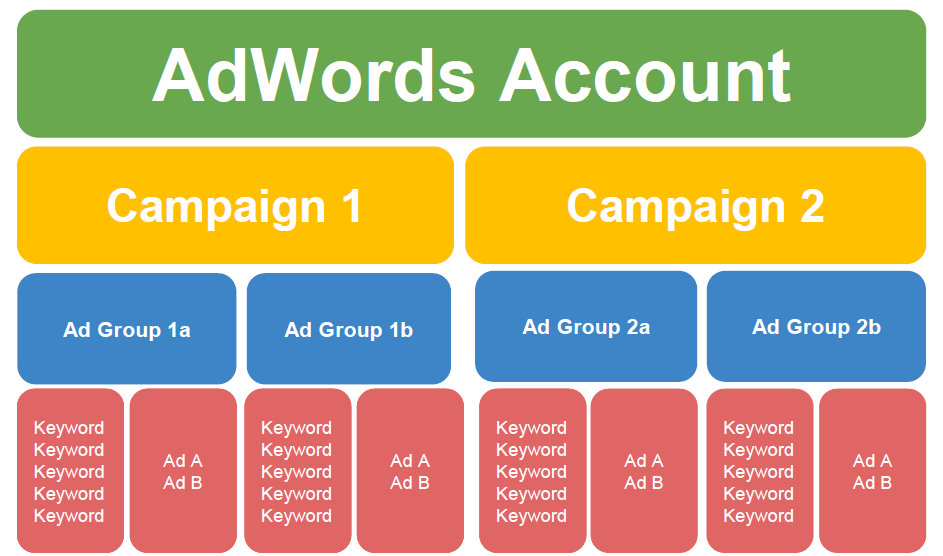
You can have up to 10,000 campaigns per account, including both active and paused campaigns. Each campaign can contain up to 20,000 ad groups (Local and App campaigns are limited to 100 ad groups per campaign). Performance Max campaigns can have up to 25 asset groups per campaign. You can have up to 5 million targeting items across the account, up to 10,000 negative keywords per campaign, and up to 5,000 negative keywords per shared negative keyword list.
In practice, the real constraints are not technical but strategic. The question is not "can I create 500 ad groups?" It is "should I?" For most accounts in 2026, the answer is no. Each ad group needs enough conversion data to contribute to Smart Bidding optimization. An ad group generating one conversion per month provides almost no useful signal. Seven to ten ad groups per Search campaign is the range most advertisers find effective. Fewer can work for niche businesses. More can work for large accounts with massive traffic. But the principle remains: consolidate enough data per ad group for the AI to learn from.
Account structure directly impacts how quickly your campaigns exit the learning phase and reach stable performance. This is one of the most underappreciated aspects of account structure decisions.
When you launch a new campaign or make significant changes (changing bid strategy, adjusting budget by more than 20%, substantially editing ads), Google's Smart Bidding enters a learning phase. During this period, the algorithm experiments with different bids, placements, and audiences to find the optimal approach. Performance is typically volatile, with CPAs often significantly higher than your target.
Google's official guidance says the learning phase requires approximately 50 conversion events or 3 conversion cycles, whichever comes first. The typical duration is about 7 days for high-volume campaigns, but low-volume campaigns can take weeks or even months to exit learning.
Here is where structure matters. If you split your traffic across 20 campaigns, each campaign gets a fraction of your total conversions. A campaign that would see 100 conversions per month as part of a consolidated structure might see only 5 conversions per month when split into 20 separate campaigns. At 5 conversions per month, that campaign may never exit the learning phase. It will remain in a perpetual state of unstable performance, spending aggressively on some days and pulling back on others, never accumulating enough data to optimize effectively.
This is the core tension in 2026 account structure: granularity gives you control but starves the algorithm. Consolidation feeds the algorithm but reduces your control and visibility. The right balance depends on your conversion volume. Google recommends a minimum of 15 conversions per month per campaign for Smart Bidding to work at all, with 30 to 50 conversions per month being the range where performance stabilizes meaningfully.
If your account generates 60 conversions per month total, you probably should not have more than 2 to 3 campaigns. If it generates 600 conversions per month, you have much more room to segment by intent, product line, or geography without starving any individual campaign.
Every time you consider creating a new campaign or splitting an existing one, ask: will each resulting campaign have enough conversions to exit the learning phase and maintain stable performance? If the answer is no, consolidate.
After analyzing countless Google Ads accounts, these are the structural problems that destroy the most budget.
Accounts still running hundreds of single keyword ad groups, or ad groups with only one or two keywords each, are fighting the AI at every turn. Each ad group generates too few impressions for RSAs to optimize, too few conversions for Smart Bidding to learn, and too little data for any pattern to emerge. The advertiser has maximum control over something that performs poorly because the system never has enough information to optimize.
The fix is straightforward. Consolidate ad groups that share the same intent. If you have separate ad groups for "buy red running shoes," "purchase red running shoes," and "red running shoes for sale," these are the same intent. Combine them into one ad group with 5 to 15 keywords and let RSAs and Smart Bidding do the work that manual optimization used to do.
The opposite mistake is equally harmful. An account with one campaign, one ad group, and 200 keywords spanning completely different intent types is a mess. "Emergency plumber" and "how much does a new sink cost" are not the same intent. They need different ad copy, different landing pages, and often different bidding targets. Lumping them together means your ad copy is generic, your landing page is a compromise, and your bidding strategy tries to optimize toward an average that does not reflect any real customer behavior.
The fix is to separate by intent. Every keyword in an ad group should have the same answer to the question "what is this person trying to do right now?" If the answer differs meaningfully, the keywords belong in different ad groups.
This is one of the most common and most expensive structural problems. When the same keyword exists in multiple campaigns, your campaigns compete against each other in the auction. Google will typically only show one ad per advertiser, but the internal competition confuses the bidding algorithm, fragments your data, and makes it impossible to know which campaign actually drove a conversion.
The most frequent version of this problem occurs between Search campaigns and Performance Max. If your Search campaign targets "red running shoes" and your PMax campaign has red running shoes in its product feed, both campaigns are eligible for the same search queries. Google claims it prioritizes the exact-match Search keyword, but in practice, PMax often captures traffic that should flow through Search.
The fix is to audit your keyword overlap. Use Google Ads Editor to export all keywords across all campaigns and check for duplicates. Where duplicates exist, decide which campaign should own that keyword and add it as a negative to the other. For Search-versus-PMax overlap, use brand exclusions and campaign-level negatives in PMax to reduce cannibalization.
Every significant structural change resets the learning phase. Advertisers who reorganize their account every few weeks, splitting campaigns, moving keywords between ad groups, changing bid strategies, are keeping their account in perpetual learning mode. The algorithm never stabilizes. Performance never reaches its potential.
Make structural changes deliberately and infrequently. When you do restructure, make the changes all at once rather than gradually over weeks. Give the new structure at least 2 to 4 weeks to stabilize before evaluating. Avoid making additional changes during the learning phase.
A campaign optimizing for lead generation and a campaign optimizing for ecommerce sales have fundamentally different conversion types, values, and cycles. If these objectives share a campaign or a bidding strategy, the algorithm is trying to optimize toward two incompatible goals simultaneously. It will compromise on both rather than excelling at either.
Separate campaigns by objective. If you have both ecommerce and lead generation goals, they need different campaigns with different bid strategies. If you are using portfolio bid strategies, only group campaigns with similar conversion types and value ranges.
Here is the most important insight about account structure that most guides miss: the right structure today is not necessarily the right structure in three months. Your business changes. Your product mix shifts. Seasonal trends alter which campaigns generate the most conversions. Competitors enter and exit your market. New Google features change what is possible.
The advertisers who perform best are not the ones who find the "perfect" structure and leave it alone. They are the ones who continuously evaluate whether their structure is helping or hindering performance and make adjustments when the data shows a problem. Is an ad group consistently getting fewer than 15 conversions per month? It might need to be consolidated into a broader ad group. Is a campaign generating high volume but wildly inconsistent quality? It might need to be split by intent type. Has a new product line grown large enough to justify its own campaign? Has PMax started cannibalizing your best Search traffic?
These are not questions you answer once. They are questions that need ongoing attention. This is where the structural conversation connects to automation. A human manager reviewing account structure once per month will catch obvious problems. But the subtle shifts, the gradual changes in keyword performance, the slow drift of PMax into low-quality inventory, the emerging ad groups that could be consolidated or need to be split, require more continuous attention than manual management can realistically provide.
groas approaches account structure as a continuous optimization problem rather than a one-time setup decision. Rather than applying a template and hoping it works, groas monitors performance data across every campaign, ad group, and keyword in real time. When an ad group is starving for data, groas identifies the consolidation opportunity. When search terms are drifting into irrelevant territory, groas adds negative keywords automatically. When a campaign's learning phase is being disrupted by structural issues, groas flags the problem before it wastes significant budget.
The best account structure is not a diagram in a blog post. It is the one that is continuously evaluated and adjusted based on your actual performance data, not a theory about how Google Ads should work, but an empirical analysis of how your campaigns actually work. Once your structure and conversion tracking are in place, groas handles the rest: bid management, budget allocation, negative keyword management, and the ongoing structural adjustments that keep the AI fed with the data it needs to perform.
For most advertisers in 2026, 7 to 10 ad groups per Search campaign is the effective range. The real constraint is not a specific number but whether each ad group generates enough conversions for Smart Bidding to optimize. If an ad group is getting fewer than 15 conversions per month, it may not have enough data for the algorithm to learn from. If you have limited conversion volume, consolidate into fewer ad groups. If you have high volume, you can afford more granular segmentation.
Google Ads allows up to 20,000 ad groups per campaign for standard campaign types. Local and App campaigns are limited to 100 ad groups per campaign. Performance Max campaigns use asset groups rather than ad groups, with a maximum of 25 asset groups per campaign. In practice, hitting these limits is rarely advisable. An account with 20,000 ad groups in a single campaign would almost certainly have severe data fragmentation issues.
For most accounts, no. SKAGs were designed for an era when exact match meant exact match and manual bidding was the norm. Since Google expanded close variants in 2018 and Responsive Search Ads replaced Expanded Text Ads, the precision advantage of SKAGs has largely disappeared. SKAGs also starve Smart Bidding and RSAs of the data they need to optimize effectively. The modern equivalent is the STAG (Single Theme Ad Group), which groups 5 to 15 keywords sharing the same intent. SKAGs may still have limited value for extremely high-value, low-volume keywords where precise control outweighs the data consolidation benefits.
Account structure directly determines how quickly campaigns exit the learning phase. The learning phase requires approximately 50 conversions or 3 conversion cycles to complete. If your structure fragments traffic across too many campaigns or ad groups, each one receives fewer conversions and takes longer to exit learning. In extreme cases, over-segmented campaigns never exit the learning phase and remain in a permanent state of unstable performance. Before adding new campaigns or splitting existing ones, verify that each resulting campaign will receive enough conversions to learn effectively. A minimum of 15 conversions per month per campaign is Google's baseline recommendation, with 30 to 50 being ideal.
For most businesses, both. They serve different functions. Search campaigns give you explicit control over which keywords trigger your ads and are best for capturing high-intent queries where you know exactly what people search for. Performance Max extends your reach across all Google inventory (Search, Shopping, Display, YouTube, Gmail, Discover) and excels at finding customers you might not have reached through Search alone. For ecommerce with product feeds, PMax is often the primary campaign type. For lead generation, Search is usually primary with PMax supplementing reach. The key is preventing cannibalization: use campaign-level negatives in PMax and brand exclusions to keep the two campaign types from competing for the same traffic.
The most effective ecommerce structure in 2026 typically includes a brand campaign (exact match on brand terms, separate budget), Performance Max campaigns segmented by product category or margin tier (each campaign groups products with similar ROAS targets), non-brand Search campaigns for category-level queries that PMax might miss or where you want more control, and optionally a Shopping campaign if you need feed-level bidding control that PMax does not offer. The critical principle is to segment PMax campaigns by business objective. Products with 60% margins and products with 15% margins should not share a campaign because their target ROAS is fundamentally different.
AI Max for Search campaigns, launched globally in May 2025, expands the capabilities of standard Search campaigns by automatically generating headlines and descriptions, matching queries beyond your explicit keyword list, and integrating with Smart Bidding Exploration to find new converting audiences. AI Max essentially makes your Search campaigns behave more like a hybrid between traditional Search and Performance Max, with the AI discovering relevant queries you may not have manually targeted. For account structure, AI Max means you can afford to be less exhaustive in your keyword lists because the AI will fill gaps. It also makes monitoring search terms more important than ever, because the AI can drift into irrelevant territory without proper negative keyword management.
Campaign-level negative keywords for PMax (introduced in 2025, up to 10,000 per campaign) are the most important tool for preventing cannibalization. Add your top-performing non-brand Search keywords as negatives in PMax to ensure those queries are served by your Search campaign. Use brand exclusions in PMax to prevent it from claiming brand traffic. Monitor the "insights" tab in PMax to see which search categories are driving conversions and compare them against your Search campaign performance. If you see the same queries appearing in both campaign types, add negatives to PMax.
For brand campaigns, Maximize Clicks or Manual CPC works well since these are high-intent queries where you want to appear consistently without overpaying. For non-brand Search campaigns, Target CPA or Target ROAS with Smart Bidding is the standard approach in 2026. For Performance Max, Target ROAS or Maximize Conversion Value are the most common strategies. For accounts managing multiple campaigns, portfolio bid strategies allow Google to dynamically allocate across campaigns to hit aggregate targets, which typically outperforms individual campaign bid strategies by 15 to 25%.
Major restructuring should be infrequent: quarterly at most, and only when data clearly shows structural problems. Signs that restructuring is needed include campaigns stuck in the learning phase due to insufficient conversions, ad groups with zero or near-zero impressions, significant keyword overlap between campaigns causing internal competition, or campaign objectives that have changed since the original structure was built. When you do restructure, make changes all at once and allow 2 to 4 weeks for the new structure to stabilize before evaluating results. Avoid making ongoing incremental structural changes, as each change restarts the learning phase.