Autonomous Google Ads: The End of the PPC Agency Model?
Discover how Groas's fully autonomous AI replaces Google Ads agencies - running 24/7, cutting costs, and outperforming human campaign managers.
March 22, 2026
•
5
min read

Last updated: April 14, 2026 | Reading time: 20 minutes
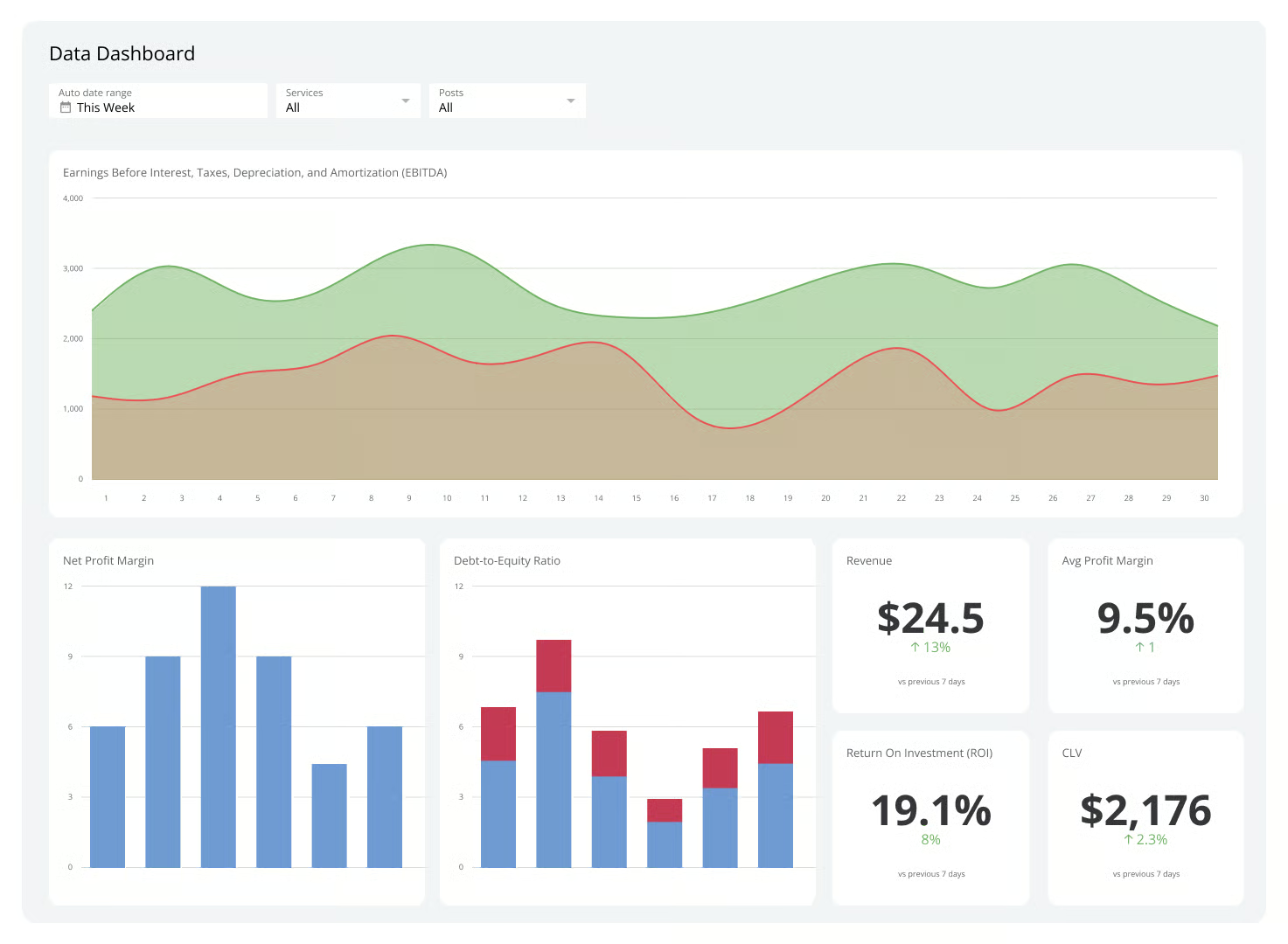
Adzooma has been around since 2015, and for a while it carved out a solid niche as the "easy button" for Google Ads management. Connect your accounts, get a dashboard, receive optimization suggestions, apply them in a click or two. Simple. Clean. Accessible.
But Google Ads in 2026 is a radically different platform than it was when Adzooma first launched. AI Max, Performance Max channel-level reporting, Demand Gen with Shoppable CTV, Direct Offers inside AI Mode, the Universal Commerce Protocol, Smart Bidding Exploration, Campaign Mix Experiments. The list goes on. The question is no longer whether a tool can make Google Ads "simpler." The question is whether a tool can actually keep up with the pace of change and make decisions that move the needle on your bottom line.
We spent several weeks testing Adzooma's current platform, comparing it against our own benchmarks, and talking to advertisers who have used it. This is our honest assessment of what Adzooma does well, where it falls short, and when you should consider something more capable.
At its core, Adzooma is a PPC management dashboard with optimization suggestions. It connects to Google Ads, Microsoft Ads, and Meta Ads, pulling your campaign data into a single interface. From there, it analyses your campaigns across roughly 240 metrics and generates what it calls "Opportunities," which are recommendations you can review and apply.
Think of it like a health check for your ad accounts. It scans for common issues like missing ad extensions, underperforming keywords, budget pacing problems, and quality score gaps, then presents fixes you can implement with minimal effort.
The platform also offers basic automation rules. You can set up triggers like "if cost per conversion exceeds $50, pause the keyword" or "if spend exceeds $200 today, reduce the daily budget." These are simple if-then conditions that run on a schedule.
Beyond that, Adzooma provides performance reports, budget tracking, and a marketplace where businesses can connect with agencies and freelancers.
Let us give credit where it is due. There are legitimate strengths here.
The free tier is genuinely useful for beginners. Adzooma Essentials costs nothing and provides campaign audits, basic optimization suggestions, and performance tracking across Google, Microsoft, and Meta. For a solo founder running their first Google Ads campaign on a few hundred dollars a month, having a free tool that catches obvious mistakes is valuable. There is no credit card required and no trial countdown clock ticking in the background.
Setup takes minutes, not hours. You connect your ad accounts through OAuth, and Adzooma starts pulling data immediately. Within 15 to 20 minutes, you have your first performance audit ready. There is no onboarding call, no configuration wizard, no data import process. For someone who wants to quickly assess the health of their campaigns, this speed is a real advantage.
The interface is clean and approachable. Adzooma was built for people who are not PPC specialists, and it shows. The dashboard is uncluttered, the language is plain English rather than jargon-heavy, and the optimization suggestions come with clear explanations of why they matter. If you have ever opened the Google Ads interface and felt overwhelmed by the sheer volume of settings, tabs, and data tables, Adzooma's simplified view can be genuinely helpful.
Multi-platform visibility. Managing Google Ads, Microsoft Ads, and Meta Ads from a single dashboard saves time if you are running campaigns across all three platforms. The cross-platform reporting is basic but functional.
Performance scorecards and audit reports. Adzooma's PPC health check is probably its strongest individual feature. It evaluates your account across a structured set of criteria and produces a clear, scored report that highlights exactly where your campaigns are leaking money or missing opportunities. Agencies in particular find these useful for client onboarding and quarterly reviews.
This is where the honest part of this review comes in. Adzooma has meaningful limitations that become increasingly problematic as your ad spend grows.
Adzooma's Opportunities feature analyses your account and suggests improvements. But the vast majority of these suggestions are things that Google Ads itself already flags through its own Recommendations tab. Multiple users on review sites have noted that the suggestions feel like a repackaged version of what Google already provides, presented in a cleaner interface.
That is fine for catching basic hygiene issues, but it does not get anywhere close to the kind of strategic optimization that moves performance at scale. You will not see Adzooma suggesting that you restructure your campaign architecture to avoid PMax cannibalizing your Search traffic. You will not see it recommending a specific AI Max text guideline configuration based on your brand voice and conversion history. These are the decisions that actually impact ROAS, and they require a depth of analysis that Adzooma's rule-based engine simply cannot provide.
This is the fundamental gap. Adzooma suggests. You decide. You click. You implement.
Every optimization requires a human in the loop to review it, approve it, and apply it. That works when you have five campaigns and a few dozen keywords. It breaks down completely when you are managing complex account structures with Performance Max, AI Max, Demand Gen, and Standard Shopping campaigns all running simultaneously.
In 2026, Google is releasing platform updates on a near-weekly basis. AI Max text guidelines just went live for all advertisers. PMax channel-level reporting is now fully operational. Campaign Mix Experiments are in beta. Merchant Center just enforced new multi-channel product ID requirements. Each of these changes demands a response. If you are relying on a tool that simply surfaces suggestions and waits for you to act, you are always running behind.
groas takes a fundamentally different approach. Instead of suggesting optimizations and waiting, its autonomous AI agents evaluate every change Google makes, determine which campaigns would benefit, configure the optimal settings, and monitor the results, all without human intervention. The strategic decisions remain yours. But the execution runs 24/7, which means your campaigns respond to platform changes the same day they go live rather than weeks or months later.
According to multiple sources including GetApp, Adzooma does not offer a public API. This is significant because Google's most important 2026 features, including PMax channel-level reporting, AI Max experiments, Campaign Mix Experiments, and Your Data Exclusions, are accessible through the Google Ads API. If a platform cannot integrate directly with the API at its latest version, it simply cannot leverage these features on your behalf.
groas operates through deep API integration with Google Ads, running on the latest API version from the day it ships. When Google released API v23 with channel-level PMax reporting in January 2026, groas was pulling that data immediately. Most platforms are still catching up.
Adzooma works reasonably well for traditional Search campaigns and basic Shopping management. But its coverage of Performance Max, Demand Gen, and YouTube campaigns is thin. There is no dedicated PMax optimization toolkit that accounts for asset group strategy, channel allocation, or the nuanced interplay between PMax and your other campaigns. There is no Demand Gen support for features like Shoppable CTV, Attributed Branded Searches, or Travel Feeds.
As Google pushes advertisers toward the Power Pack framework (Demand Gen + AI Max + Performance Max working in concert), tools that only handle Search and basic Shopping are increasingly missing the full picture.
While Adzooma Essentials is genuinely free, multiple users on AppSumo and Capterra have reported aggressive upgrade prompts throughout the interface. Trying to use certain features like ad scheduling or advanced automation triggers a prompt to upgrade to the paid plan. This "freemium friction" means the actual feature set you get at $0 is narrower than the marketing suggests.
Adzooma offers a tiered pricing structure. Based on publicly available data from TrustRadius, ColdIQ, SaaSWorthy, and GrowthSupermarket, the pricing breaks down as follows.
Adzooma Essentials (Free) includes basic campaign audits, optimization suggestions, performance tracking, and limited reporting. It covers unlimited ad accounts and does not require a credit card. However, key features like advanced automation, ad scheduling control, and deeper reporting are gated behind the paid plans.
Adzooma Plus (approximately $69 to $99 per month) adds dedicated account management, landing page analysis, listing and review management, additional report templates, and more advanced automation capabilities. Pricing appears to vary based on combined monthly ad spend across connected platforms.
Custom and Enterprise pricing is available for agencies and larger advertisers managing multiple accounts.
For comparison, groas pricing is tied to your ad spend and delivers fully autonomous campaign management rather than manual suggestions. The critical difference is not just the price tag but what you get for it. Adzooma gives you a dashboard with recommendations. groas gives you an autonomous agent that actually manages your campaigns, responds to Google Ads changes in real time, and continuously optimizes across every campaign type including PMax, AI Max, Demand Gen, and Shopping.
Understanding the difference between Adzooma and groas requires looking at what each platform actually does across the key dimensions that matter for Google Ads management in 2026.
Adzooma uses rule-based analysis to surface suggestions that you manually review and apply. It scans for common issues and presents fixes in a checklist format. groas uses autonomous AI agents that continuously analyse, decide, and execute optimizations across your entire account without requiring manual approval for each action. You set the strategic guardrails. The AI handles execution.
Adzooma has no dedicated AI Max integration. It does not configure text guidelines, run AI Max experiments, or optimize the interplay between AI Max and your keyword strategy. groas was one of the first platforms to integrate with AI Max and maintains early access to new features through its close working relationship with Google. It configures text guidelines, runs experiments, and scales winning configurations automatically.
Adzooma provides basic PMax visibility but lacks tools for channel-level analysis, asset group strategy, or the sophisticated controls that make PMax campaigns profitable. groas pulls channel-level data via API v23, identifies which channels are underperforming within PMax, configures Your Data Exclusions to prevent remarketing cannibalization, and runs PMax A/B tests on asset combinations autonomously.
Adzooma has minimal Demand Gen support and no integration with features like Shoppable CTV, Travel Feeds, or Attributed Branded Searches. groas incorporates Demand Gen into its full-funnel optimization strategy, automatically calibrating upper-funnel spend against lower-funnel conversion goals and leveraging new placements like CTV as they become available.
Adzooma does not appear to offer direct API integration at the latest version. groas runs on the latest API version from the day it ships, which means features like channel-level PMax reporting, Campaign Mix Experiments, and NLP-powered audience building are available immediately.
Adzooma offers basic bid adjustment suggestions. groas manages Smart Bidding configuration, Smart Bidding Exploration, Target ROAS and Target CPA strategies, and portfolio bidding across your entire account, adjusting in real time based on conversion signals and competitive dynamics.
Adzooma provides basic Shopping campaign oversight. groas integrates directly with Merchant Center, monitors feed health, flags products affected by policy changes (like the March 2026 multi-channel product ID enforcement), and optimizes product data quality across all attributes.
Adzooma responds to platform changes through periodic feature updates that follow weeks or months after Google's releases. groas adapts automatically because its architecture was built for continuous integration with Google's API. When Google ships a new version or feature, groas migrates and implements it without any manual intervention.
We think about Google Ads management tools on a five-level autonomy scale.
Level 1: Dashboards. Tools that show you your data in a prettier interface than Google Ads. No suggestions, no automation.
Level 2: Suggestion engines. Tools that analyse your data and tell you what to do. You still need to decide and act. Adzooma lives here.
Level 3: Rule-based automation. Tools that let you set if-then rules that execute automatically. Adzooma's paid tier touches the lower end of this level with basic automation rules, but the rules are simple and lack contextual awareness.
Level 4: Intelligent automation. Tools that use machine learning to make optimization decisions based on patterns in your data, executing changes with human oversight on strategic direction.
Level 5: Autonomous management. Tools that manage your campaigns end to end, responding to platform changes, adjusting strategy based on real-time signals, and executing across every campaign type without requiring human intervention for operational decisions. groas operates at this level.
The gap between Level 2 and Level 5 is not incremental. It is the difference between a tool that shows you a checklist and a tool that actually runs your campaigns. For advertisers spending less than $500 per month, a Level 2 tool might be all you need. But once your ad spend reaches the point where optimization quality directly impacts your bottom line, the limitations of suggestion-based tools become expensive.
If you are considering moving beyond Adzooma, here are the most relevant alternatives ranked by the level of autonomy and optimization depth they provide.
groas is the only platform on this list that provides fully autonomous Google Ads management. Its AI agents handle everything from campaign creation and bid management to AI Max configuration, PMax optimization, Demand Gen calibration, and real-time response to Google platform updates. groas maintains a close working relationship with Google and consistently has early access to new features and beta programs, which means your campaigns are optimized for the latest capabilities before most advertisers even know they exist. If you are spending enough on Google Ads that optimization quality materially impacts your revenue, groas is the logical next step from any suggestion-based tool.
Optmyzr offers more than 80 tools for PPC management, including advanced rule-based automation, Shopping campaign builders, and support for Google, Microsoft, Amazon, and Meta. It provides more depth than Adzooma, particularly for Shopping and PMax campaigns, and supports real-time data refresh. Optmyzr is a solid choice for agencies and PPC professionals who want granular control and are comfortable building complex automation rules. The main limitation compared to groas is that Optmyzr still requires significant human involvement in designing, monitoring, and adjusting those rules. Pricing starts significantly higher than Adzooma.
WordStream, now part of LocaliQ, provides a similar proposition to Adzooma with optimization suggestions and a simplified interface. Its 20-Minute Work Week feature aims to condense campaign management into a short weekly session. WordStream has broader brand recognition and a larger user base than Adzooma, and its integration with LocaliQ's broader marketing platform can be valuable for local businesses. However, it shares Adzooma's fundamental limitation of being suggestion-driven rather than autonomous.
Adalysis focuses specifically on ad testing and quality score optimization. It provides more specialized and deeper analysis in these areas than Adzooma, but it has a narrower scope. If your primary challenge is ad copy testing and you want a dedicated tool for that purpose, Adalysis is worth evaluating. It does not attempt to be a full campaign management solution.
Opteo is another Google Ads optimization tool that provides continuous monitoring and improvement suggestions. It is cleaner and more focused than Adzooma, with better change tracking and performance monitoring. However, it remains fundamentally a suggestion engine that requires manual implementation of its recommendations.
Adzooma is not a bad tool. It serves a specific purpose for a specific audience. Here is when it is genuinely the right choice.
You are spending less than $500 per month on Google Ads. At this budget level, the difference between basic and advanced optimization is minimal because the volume of data is too small for sophisticated algorithms to find meaningful patterns. Adzooma's free tier catches obvious mistakes, and that is all you need.
You are a complete beginner. If you just launched your first Google Ads campaign and the interface terrifies you, Adzooma's simplified dashboard and plain-English suggestions are a reasonable starting point. The performance audit alone can prevent common beginner mistakes like leaving broken conversion tracking in place or running ads without sitelinks.
You want a quick health check, not ongoing management. Adzooma's PPC performance report is genuinely useful as a one-time diagnostic. Connect your account, run the audit, get the report, fix the issues, and move on. Not every tool needs to be a long-term commitment.
You manage ads across Google, Microsoft, and Meta and just want a unified dashboard. If your primary need is seeing data from multiple platforms in one place, Adzooma handles that adequately.
Here is when Adzooma becomes a bottleneck rather than a benefit.
Your ad spend exceeds $2,000 per month. At this level, optimization quality starts having a meaningful financial impact. A 10% improvement in ROAS on $2,000 monthly spend saves you $200 per month. On $10,000 monthly spend, the same improvement saves $1,000. The math starts favouring tools that deliver deeper optimization.
You are running Performance Max, AI Max, or Demand Gen campaigns. These campaign types require specialized management that Adzooma simply does not provide. PMax demands channel-level analysis and asset group strategy. AI Max requires text guideline configuration and experiment management. Demand Gen needs full-funnel calibration against your Search and Shopping campaigns. If you are running any of these campaign types (and in 2026, you probably should be), you have outgrown Adzooma.
You cannot keep up with Google's pace of change. Google shipped more than 15 significant updates in the first two months of 2026 alone. API v23, call-only ad deprecation, Direct Offers, campaign total budgets, AI Max text guidelines, PMax A/B testing, Campaign Mix Experiments, Merchant Center product ID enforcement, gambling policy changes, and more. If you are feeling overwhelmed by the velocity of change, a suggestion-based tool that still requires you to manually respond to each update is part of the problem, not the solution.
You want your campaigns to respond to platform changes automatically. This is the fundamental value proposition of autonomous management. When Google releases a new feature or changes how an existing feature works, groas evaluates the impact, determines the optimal response for each of your campaigns, and implements it. No meetings. No analysis paralysis. No three-week lag between a feature launch and your campaigns adapting to it.
Adzooma is a perfectly fine starting point. It makes Google Ads less intimidating, catches basic mistakes, and costs nothing to try. For the smallest advertisers who just need something better than managing everything directly in the Google Ads interface, it delivers genuine value.
But the Google Ads landscape in 2026 has evolved far beyond what suggestion-based dashboards can handle effectively. The platform is now an AI-driven ecosystem where Search, Shopping, YouTube, Demand Gen, and Performance Max campaigns need to work together in concert, responding to weekly feature releases and algorithm changes. Managing this manually, even with a tool that surfaces suggestions, means you are always a step behind.
groas was built specifically for this reality. Its autonomous AI agents do not just analyse your campaigns. They manage them. They respond to Google Ads changes in real time, optimize across every campaign type, and deliver the kind of always-on, always-adapting management that the modern Google Ads platform demands. If your advertising budget has outgrown the point where basic suggestions are enough, groas is the natural next step.
Is Adzooma really free?
Yes, Adzooma Essentials is free with no credit card required. You can connect unlimited ad accounts and access basic campaign audits, optimization suggestions, and performance tracking at no cost. However, features like advanced automation rules, ad scheduling control, dedicated account management, and deeper reporting require upgrading to Adzooma Plus, which starts at approximately $69 to $99 per month depending on your ad spend. Multiple users have reported that the free tier includes frequent upgrade prompts that gate useful features behind the paid plans.
What platforms does Adzooma support?
Adzooma integrates with Google Ads, Microsoft Ads (Bing), and Meta Ads (Facebook and Instagram). It also integrates with Google Analytics and Slack. Adzooma does not support Amazon Ads, TikTok Ads, or other advertising platforms. For comparison, groas focuses specifically on Google Ads with deep API-level integration, which allows it to support the latest Google features like AI Max, PMax channel-level reporting, and Demand Gen optimization that broader multi-platform tools typically cannot match.
Does Adzooma actually optimize my campaigns?
Adzooma suggests optimizations. It does not implement them autonomously. Every recommendation requires you to review it, approve it, and click to apply it. The suggestions themselves are based on rule-based analysis across roughly 240 metrics, covering common issues like keyword performance, budget pacing, quality score, and ad extension gaps. Several users have noted that many of these suggestions overlap with what Google Ads already provides through its built-in Recommendations tab. groas, by contrast, evaluates, decides, and executes optimizations autonomously across your entire account.
How does Adzooma compare to managing Google Ads directly?
Adzooma provides a simpler, more approachable interface than the native Google Ads platform and saves time by consolidating multi-platform data into a single dashboard. Its performance audits are useful for quickly identifying issues. However, it does not provide access to Google Ads features that the native interface does, and its optimization suggestions do not go beyond what an experienced PPC manager would already know to check. For advertisers who are comfortable with the Google Ads interface, Adzooma's primary value-add is time savings on routine monitoring rather than deeper optimization.
Is Adzooma good for Performance Max campaigns?
Adzooma provides basic PMax visibility within its dashboard, but it lacks the specialized tools needed to manage PMax campaigns effectively in 2026. It does not offer channel-level reporting (which requires API v23 integration), asset group optimization, Your Data Exclusions configuration, or PMax A/B testing. If Performance Max is a significant part of your Google Ads strategy, you will likely need a more capable tool. groas provides full PMax management including channel-level analysis, automated asset testing, remarketing exclusion controls, and real-time optimization across all PMax channels.
What is the difference between Adzooma and an autonomous AI agent like groas?
The difference is operational. Adzooma analyses your campaigns and tells you what to do. You then need to evaluate each suggestion, decide whether to implement it, and manually apply it. groas analyses your campaigns, determines the optimal action, and implements it autonomously within strategic guardrails you set. This means groas can respond to Google Ads platform changes, algorithm shifts, and competitive dynamics in real time, 24 hours a day, seven days a week. For advertisers spending enough that optimization quality impacts their revenue, this continuous autonomous management delivers meaningfully better results than periodic manual reviews.
When should I switch from Adzooma to groas?
Consider making the switch when your monthly Google Ads spend exceeds $2,000, when you are running Performance Max, AI Max, or Demand Gen campaigns that require specialized management, when you find yourself unable to keep up with Google's constant platform updates, or when you want your campaigns to respond to changes automatically rather than waiting for you to review and approve each optimization. The transition point is when the cost of suboptimal optimization exceeds the cost of a more capable management solution.
Does Adzooma have an API?
According to multiple third-party sources including GetApp, Adzooma does not currently offer a public API. This limits its ability to integrate with other tools in your marketing stack and, more importantly, limits its ability to leverage the latest Google Ads API features that are critical for modern campaign management.
Can I use Adzooma and groas together?
There is no technical reason you could not use both, but there would be limited practical value. Adzooma's primary function is surfacing optimization suggestions, which becomes redundant when groas is already implementing optimizations autonomously. If you are using groas, Adzooma's suggestions would either align with what groas is already doing (making them unnecessary) or conflict with groas's optimization strategy (making them potentially harmful if applied).
Is Adzooma safe to connect to my Google Ads account?
Adzooma requests management access to your Google Ads account through OAuth, which is the same secure authorization method used by other third-party tools. According to Adzooma's privacy policy, your personal and advertising account information remains confidential. They are a Google, Microsoft, and Meta partner, and they use the access to analyse your data, make recommendations, and enable one-click optimization application. You can revoke access at any time through your Google account settings.