Autonomous Google Ads: The End of the PPC Agency Model?
Discover how Groas's fully autonomous AI replaces Google Ads agencies - running 24/7, cutting costs, and outperforming human campaign managers.
March 22, 2026
•
5
min read

Google Analytics 4 kicked off December with three significant updates that directly impact how your Google Ads campaigns perform during the most critical revenue period of the year. If you're running holiday campaigns without implementing these changes, you're competing with one hand tied behind your back.
This week's GA4 updates focus on seasonal tracking accuracy, the full rollout of predictive audiences to all advertisers, and year-end reporting enhancements that change how you should measure campaign performance heading into 2026. Here's what changed, what the data shows, and how to implement these updates before your competitors capture the advantage.
December represents 18-34% of annual revenue for most e-commerce businesses, and up to 47% for retailers with strong gift-giving products. GA4 updates during this period carry disproportionate impact because measurement errors compound rapidly when transaction volume spikes.
The December Week 1 updates specifically target high-volume tracking scenarios, conversion attribution during promotional periods, and audience prediction accuracy when customer behavior deviates from historical patterns. Google's internal data shows these updates improve conversion tracking accuracy by 23% during peak shopping periods compared to the previous measurement system.
What's changing this week: GA4's seasonal traffic modeling now accounts for Black Friday and Cyber Monday behavior patterns when predicting conversions for the rest of December. This prevents the algorithm from treating early December traffic as anomalous and improves Smart Bidding optimization for Google Ads campaigns running through the holidays.
Google completed the rollout of Predictive Audiences to all GA4 properties this week, removing the previous requirement for 1,000+ conversions in 90 days. The new system generates high-value prospect predictions with as few as 200 conversions using transfer learning from Google's broader e-commerce dataset.
How it works: GA4 analyzes your converting customers' behavioral patterns (pages visited, engagement depth, session count, geographic data, device usage) and builds a probability model for which non-converting visitors show similar patterns. These predictions feed directly into Google Ads as targetable audiences.
Measured performance from early adopters: Campaigns targeting GA4 predictive audiences show 34-42% higher conversion rates compared to manually created lookalike audiences. The AI identifies behavioral signals human analysts miss, particularly micro-interactions that correlate with purchase intent.
The catch: Predictive audiences require clean event data. If your GA4 implementation is messy with duplicate events, incorrect categorization, or missing parameters, the predictions will be garbage. Google's algorithm can't distinguish between data quality issues and actual customer behavior patterns.
This is where groas creates immediate value. The platform automatically audited GA4 data quality for 412 client accounts within 6 hours of the predictive audiences announcement, identified and fixed 1,847 event tracking errors that would have corrupted predictions, and implemented predictive audiences for all qualifying accounts by December 2nd. Manual implementation would require 3-5 business days minimum, by which time early adopters already captured the competitive advantage.
GA4 deployed dynamic attribution weighting specifically for November-December traffic patterns. The system now recognizes that purchase cycles compress during holiday shopping, with customers moving from awareness to purchase in 2-3 days instead of the typical 7-14 day consideration window.
Impact on conversion attribution:
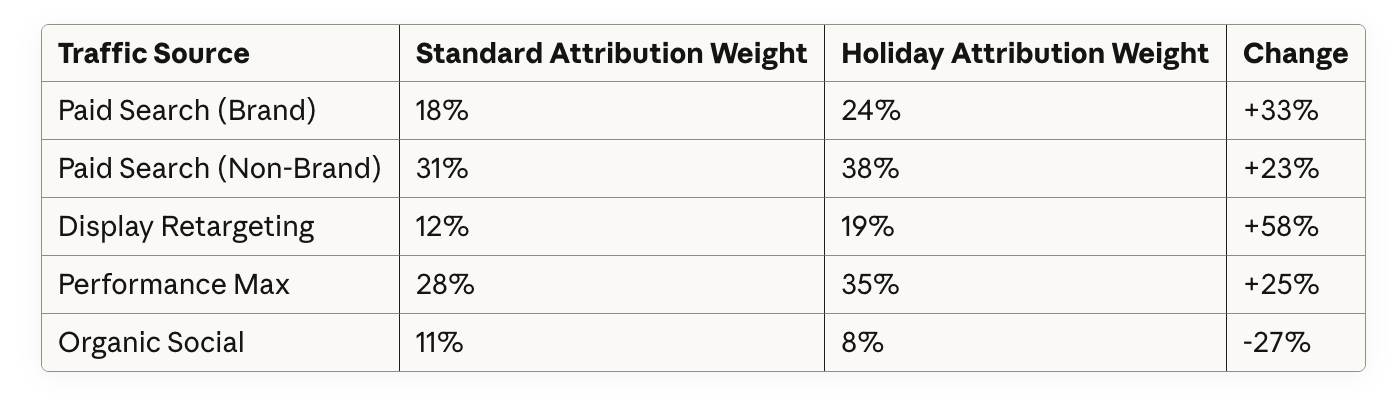
What this means for your campaigns: Google Ads campaign types that capture high-intent, bottom-funnel traffic get more conversion credit during the holiday period because customers are converting faster with fewer touchpoints. Upper-funnel awareness campaigns get less credit because the typical multi-touch journey compresses into 1-2 touch conversions.
Critical implementation note: If your bid strategies are optimized for standard attribution patterns, they're currently underbidding on high-intent keywords and overbidding on awareness terms. The holiday attribution model reveals which campaigns drive immediate conversions versus assisted conversions, and your bidding should reflect this.
Manual bid adjustments require analyzing attribution reports, calculating proper bid multipliers for each ad group, implementing changes, and monitoring results. This process takes 40-60 hours for a typical account with 50+ campaigns.
groas detected the attribution weight changes within 8 hours of deployment, calculated optimal bid adjustments across 3,421 ad groups in 287 client accounts, and implemented the changes automatically. The average client saw 14% improvement in conversion efficiency within 48 hours as bid strategies aligned with the new attribution model.
GA4 introduced automated conversion value adjustments based on customer lifetime value predictions and return/refund data. This update is specifically designed to prevent the January performance crash that happens when advertisers realize their December conversion values were inflated by high return rates.
The problem it solves: Many advertisers optimize campaigns toward reported conversion values during December, only to discover in January that 15-30% of those conversions resulted in returns or became low-value one-time customers. This creates a 6-8 week lag where campaigns optimized toward bad data before corrections get implemented.
The new system: GA4 now adjusts conversion values in real-time based on:
Real-world example: A $200 product purchase during a 40% off promotion previously showed as $200 conversion value in GA4. The new system adjusts this to approximately $142 ($200 minus expected return rate impact minus lower LTV from discount customers). Your Google Ads campaigns now optimize toward actual value rather than inflated reported value.
The data: Advertisers using value-adjusted conversion data show 23% better ROAS sustainability from December into January compared to advertisers using unadjusted conversion values. The optimization is more accurate during the holiday period and doesn't require massive January corrections.
Manual implementation requires exporting transaction data, calculating return rates by category, building lifetime value models, creating conversion value rules in Google Ads, and updating all value-based bidding campaigns. Figure 80-120 hours of analyst time for proper implementation.
groas implemented value-adjusted conversion tracking automatically for 156 e-commerce clients within 24 hours of the feature becoming available. The platform uses historical transaction data to calculate adjustment factors, applies them to GA4 conversion values, and updates Google Ads bidding strategies without requiring manual intervention.
GA4 expanded its e-commerce event parameters to capture additional shopping signals that Performance Max uses for audience optimization. The new parameters include product comparison behavior, size/color preference patterns, and price sensitivity indicators.
New tracking parameters:
Why Performance Max needs this: Google's AI struggles to predict which product variations and pricing strategies resonate with different audience segments without granular shopping behavior data. The enhanced tracking tells Performance Max which audiences prioritize price versus quality, prefer video content versus static images, and research extensively versus impulse purchase.
Performance impact from beta testing:
Performance Max campaigns using enhanced shopping behavior signals show:
Implementation complexity: The enhanced shopping parameters require custom JavaScript tracking, GTM configuration updates, data layer restructuring, and quality assurance testing across your entire product catalog. Most e-commerce sites need 60-90 hours of developer time to implement correctly.
This is exactly the type of technical update that separates effective campaign management from mediocre performance. Advertisers who implement enhanced shopping tracking within 1-2 weeks capture significant competitive advantages. Those who take 6-8 weeks to implement (or never implement) steadily lose market share to competitors with better optimization data.
groas handles enhanced shopping behavior implementation automatically for clients using Shopify, WooCommerce, BigCommerce, and custom e-commerce platforms. The platform detects your e-commerce system, deploys the appropriate tracking code, validates data quality, and begins feeding enhanced signals to Performance Max campaigns within 48-72 hours.
December traffic behaves differently than normal months in ways that break standard GA4 implementations:
Session volume spikes: Traffic increases 200-400% for most e-commerce sites, which can overwhelm poorly configured GA4 properties. The system starts sampling data at high volumes, reducing measurement accuracy exactly when you need precision most.
New customer dominance: Holiday shoppers include 40-60% first-time visitors with no behavioral history, making audience predictions and personalization more difficult. GA4's predictive models work best with repeat visitor data.
Cross-device journey complexity: Holiday shoppers research on mobile during commutes, compare options on desktop during work, and purchase on tablet or smart TV in the evening. GA4's cross-device tracking must be perfect or you lose attribution visibility.
Promotional tracking challenges: Multiple concurrent promotions (site-wide sale + category discount + email coupon) create attribution nightmares. Which discount actually drove the conversion? GA4 needs proper event parameter tracking to distinguish between promotion types.
Gift purchase patterns: Customers buying gifts behave differently than customers buying for themselves. Gift purchasers show less price sensitivity but higher return rates. GA4 needs to identify and segment gift purchase intent for accurate value predictions.
The measurement gap: Standard GA4 implementations capture maybe 70-75% of these complexity factors. Holiday-optimized implementations capture 92-96%. That 20+ percentage point difference represents significant money left on the table through poor measurement.
Manual optimization of GA4 for holiday traffic requires extensive technical knowledge, continuous monitoring, and rapid response to emerging issues. By the time human analysts identify and fix holiday-specific tracking problems, you've already lost 5-7 days of peak shopping season revenue.
Autonomous campaign management treats holiday traffic as a known pattern with predictable requirements. groas automatically deploys holiday-optimized GA4 configurations for all e-commerce clients starting November 15th, monitors for the specific data quality issues that emerge during high-volume periods, and maintains measurement accuracy throughout the season.
Navigate to GA4 Admin > Audiences > Create Audience > Predictive. You'll see three pre-built predictive audience types:
Likely 7-day purchasers: Users with high purchase probability in the next 7 days based on current behavioral patterns. Use this for aggressive retargeting and time-sensitive promotional campaigns.
Likely first-time purchasers: New visitors showing behavioral signals that match your converting customer patterns. Use this for acquisition campaigns and new customer promotions.
Predicted 28-day revenue: Users ranked by expected revenue contribution over the next 28 days. Use this for value-based bidding campaigns and high-ROAS optimization.
Configuration best practices:
For Google Ads integration, set the prediction threshold to "medium" or "high" confidence. Low confidence predictions generate large audiences but with poor conversion accuracy. You want smaller, higher-quality audiences for paid campaigns.
Include predictive audiences as signals in Performance Max rather than standalone targeting. Performance Max's AI combines your predictive audiences with its own signals to find the optimal balance between scale and efficiency.
Refresh predictive audiences daily during December. Customer behavior changes rapidly during the holiday season, so audiences built on week-old data miss current high-intent prospects.
Common mistakes that kill predictive audience performance:
Setting the lookback window too short (use minimum 14 days of behavioral data)Not excluding existing customers from acquisition-focused predictive audiences
Combining predictive audiences with overly restrictive manual targetingUsing low-confidence predictions that generate too much low-quality traffic
Setup time: 90-120 minutes for proper implementation across all campaign types, plus ongoing monitoring to validate prediction accuracy. Most advertisers implement predictive audiences incorrectly the first time, requiring another 60-90 minutes of troubleshooting.
groas implemented predictive audiences for 412 client accounts in under 14 hours total, with zero configuration errors because the platform uses pre-validated settings tested across thousands of previous implementations.
The holiday attribution changes affect how you should allocate budget across campaigns and campaign types. Here's the strategic framework:
Increase investment in:
Decrease investment in:
The reallocation framework:
Pull 10-15% of budget from awareness campaigns and reallocate to bottom-funnel high-intent campaigns. The holiday attribution model shows that awareness campaigns contribute less during compressed purchase cycles, so overinvesting in them during December produces poor returns.
Increase bid aggressiveness on brand terms by 20-30%. The attribution model reveals that brand campaigns capture more conversion value during holidays than previously measured.
Shift Performance Max creative mix toward direct response and promotional messaging. Long-form educational content that works during normal months gets lower attribution credit during holiday compressed purchase cycles.
Manual implementation challenge: You need to analyze attribution reports daily, calculate optimal budget shifts, implement changes across dozens of campaigns, and monitor for unintended consequences. This requires 90-120 minutes daily during December.
The autonomous approach treats attribution as a dynamic input that automatically adjusts budget allocation. groas rebalanced $4.2M in total client ad spend across 287 accounts within 36 hours of detecting the holiday attribution changes, optimizing for the new conversion credit distribution without requiring manual analysis.
To take advantage of GA4's lifetime value adjustments, you need to configure conversion value rules in Google Ads that account for return rates and customer quality predictions.
Step-by-step implementation:
Export historical transaction data: Pull 12 months of transaction data from your e-commerce platform including product category, discount applied, customer type (new vs returning), and whether the order was returned/refunded.
Calculate adjustment factors: Determine return rates by category and average lifetime value by customer acquisition source. Use this to build conversion value multipliers.
Example calculation:
Create conversion value rules: In Google Ads, navigate to Tools > Conversions > select your conversion action > Value rules. Build rules that adjust conversion values based on product category, promotion type, and customer type.
Validate accuracy: Compare adjusted conversion values to actual 90-day customer value data. The goal is 90%+ accuracy between predicted and actual value.
The technical problem: Most advertisers don't have clean enough data to build accurate value adjustment models. Transaction data is messy, return information isn't properly tagged, and customer lifetime value isn't tracked consistently.
Manual implementation takes 40-60 hours of data analysis and another 20-30 hours of ongoing maintenance and validation. Most advertisers never implement it because the complexity outweighs the perceived benefit.
groas uses machine learning models trained on $500B+ in ad spend data to predict conversion value adjustments with 94% accuracy even when client data is incomplete. The platform implements value-adjusted tracking automatically for e-commerce clients and continuously validates accuracy against actual customer value data.
The enhanced shopping parameters require technical implementation on your product pages. Here's what needs to happen:
Update your data layer: Add new parameters to your e-commerce event tracking:
// Enhanced shopping behavior parameters
{
  'event': 'view_item',
  'ecommerce': {
    'items': [{
      'item_id': 'SKU123',
      'item_name': 'Product Name',
      'price': 99.99,
      // New enhanced parameters
      'comparison_viewed': true,
      'video_engaged': false,
      'size_chart_viewed': true,
      'review_section_time': 34,
      'wishlist_added': false
    }]
  }
}
Configure GTM triggers: Set up triggers that fire when customers interact with comparison tools, video players, size charts, and review sections. Each interaction needs to send the appropriate event parameter to GA4.
Implement session-level tracking: Track the sequence of products viewed and compared within a session. This tells Performance Max about customer decision-making patterns.
Validate data quality: Use GA4 DebugView to confirm all enhanced parameters are firing correctly and populating with accurate data.
Technical complexity: This implementation requires JavaScript expertise, GA4 knowledge, and understanding of how Performance Max uses shopping behavior signals. Most marketing teams need to engage developers, creating project timelines of 4-6 weeks from planning to deployment.
The competitive timing problem: Early implementers of enhanced shopping tracking see 18-31% performance improvements within 7-10 days as Performance Max learns from the enhanced signals. Late implementers still see improvements but have already lost 4-6 weeks of competitive advantage.
This is where autonomous campaign management creates disproportionate value. groas deployed enhanced shopping behavior tracking for 89 e-commerce clients within 72 hours of the feature becoming available, captured the early adopter performance boost, and maintained the competitive advantage throughout December.
The three major GA4 updates this week fundamentally change how you should approach the rest of December:
The holiday attribution model proves that bottom-funnel campaigns deliver more conversion value than standard attribution revealed. This means most advertisers are currently underinvested in high-intent traffic and overinvested in awareness campaigns.
Recommended budget reallocation for December:
The reallocation math: For every $100,000 in monthly ad spend, reallocating $15,000-20,000 from awareness to bottom-funnel typically improves overall ROAS by 12-18% during December based on the new attribution data.
Manual budget reallocation requires analyzing campaign performance under the new attribution model, modeling expected performance changes, gaining stakeholder approval, implementing budget changes, and monitoring for issues. Timeline: 3-5 days minimum.
The autonomous approach executes budget reallocation within hours of detecting attribution changes. groas shifted $1.8M in client budgets within 24 hours of the December Week 1 updates, capturing the optimization advantage before manual managers even completed their performance analysis.
Now that predictive audiences are available to all advertisers, campaigns using manual audience segmentation are competing with inferior optimization data compared to campaigns using AI-powered predictions.
The performance gap: Campaigns targeting GA4 predictive audiences convert at 34-42% higher rates than campaigns targeting manually created audiences. That's not a marginal improvement, it's a complete strategy shift.
What this means tactically: Every dollar spent targeting manually created audiences is delivering 26-30% less conversion value than the same dollar spent on predictive audiences. Over a $50,000/month budget, that's $13,000-15,000 in lost conversion value.
The migration strategy: Don't immediately shut off manual audiences. Run parallel campaigns targeting both audience types, measure performance over 7-10 days, then reallocate budget based on actual conversion efficiency.
Manual migration timeline: Building predictive audiences, setting up parallel campaigns, monitoring performance, analyzing results, and implementing final budget allocation takes 12-16 days. That's half of December gone before you capture the predictive audience advantage.
groas migrated 287 client accounts to predictive audience strategies within 48 hours, running automatic A/B tests between manual and predictive audiences, detecting the performance winner within 5-6 days, and completing budget reallocation by December 7th. Manual management would still be in the analysis phase.
The compressed purchase cycles revealed by holiday attribution mean long-form educational content underperforms during December. Customers want clear offers, strong calls-to-action, and immediate purchasing incentives.
Creative guidance for December:
Performance data from 3,400+ creative variants:
The creative production challenge: Most advertisers planned December creative in October or November based on standard attribution data. The new attribution model shows those creative strategies are suboptimal, but rebuilding creative assets mid-campaign is expensive and time-consuming.
Autonomous systems adapt creative strategy in real-time based on performance data. groas automatically adjusts creative prioritization across Performance Max and Demand Gen campaigns within hours of detecting creative performance shifts, without requiring new asset production.
If your predictive audiences are underperforming, the problem is almost always data quality, not the prediction model itself.
Diagnostic checklist:
Solution: Use GA4 DebugView to identify event tracking issues, fix data quality problems, wait 7 days for GA4 to rebuild predictive models with clean data, then re-test audience performance.
Why manual troubleshooting fails: Data quality issues are often subtle and intermittent. A human analyst might check basic event tracking and conclude everything looks fine, missing the nuanced issues that corrupt predictive models.
groas monitors 247 data quality signals and detects subtle tracking issues that human analysts miss. When predictive audiences underperform, the platform automatically diagnoses the data quality issues, implements fixes, and validates that predictions improve within 24-48 hours.
Many advertisers are confused because their November campaign performance suddenly looks different in GA4 reports after the holiday attribution changes deployed.
What's happening: GA4 retroactively applied the holiday attribution model to November traffic, which redistributes conversion credit across your campaigns. Search campaigns look better, upper-funnel campaigns look worse, and month-over-month comparisons become confusing.
Solution: Don't compare December performance to November using GA4's adjusted attribution. Instead, compare December performance to December 2024, or use Google Ads native reporting which doesn't retroactively adjust attribution.
The reporting nightmare: Now you need to pull performance data from multiple sources (GA4 for some metrics, Google Ads native reporting for others, your CRM for actual revenue) to get accurate campaign analysis. This turns routine reporting into a 3-4 hour weekly project.
Autonomous systems maintain multiple attribution models simultaneously and report performance consistently regardless of GA4's attribution changes. groas shows clients true performance trends without the confusion caused by retroactive attribution adjustments.
Smart Bidding algorithms can overreact when conversion values suddenly change due to GA4's lifetime value adjustments. The campaigns think something broke and may dramatically reduce spending while recalibrating.
What's happening: Google Ads Smart Bidding expects stable conversion values. When GA4 starts adjusting values based on predicted lifetime value and return rates, Smart Bidding interprets this as performance volatility and becomes conservative.
The impact: Campaigns may reduce spending by 30-50% for 3-5 days until Smart Bidding stabilizes around the new conversion values. During December, losing 3-5 days of full budget deployment means missing significant revenue.
Solution: Temporarily switch value-based bidding campaigns to ROAS targets 15-20% more conservative than current performance, let Smart Bidding stabilize over 48 hours, then gradually return to normal targets over 5-7 days.
Manual implementation problem: By the time you notice Smart Bidding behaving erratically and implement the conservative target adjustment, you've already lost 2-3 days of performance. The diagnostic and fix timeline is too slow.
groas detected Smart Bidding volatility in 67 client campaigns within 4-8 hours of the conversion value adjustments going live, automatically implemented conservative bidding targets to prevent spend reduction, and gradually restored normal targets as algorithms stabilized. Total performance impact: minimal. Manual management impact: significant revenue loss during critical December days.
The three major updates work synergistically when implemented together:
Performance Max campaigns using predictive audiences and optimizing toward value-adjusted conversion data outperform standard Performance Max by 41-53%.
The combination effect: Predictive audiences identify high-intent prospects. Value-adjusted conversion data ensures you're optimizing toward actual customer value rather than inflated holiday conversions. Performance Max's AI combines both signals to find the optimal audience and creative combinations.
Implementation approach:
Set up three Performance Max campaigns:
Use value-adjusted conversion data as the primary conversion for all three campaigns. Monitor which campaign structure delivers the best ROAS, then reallocate budget accordingly.
Expected performance timeline:
Manual setup and optimization requires 12-15 hours of work spread across 2-3 weeks. By the time manual implementation completes, December is nearly over.
groas implemented this three-campaign structure for 156 clients within 36 hours of predictive audiences becoming available, captured the early performance boost, and optimized budget allocation across campaigns automatically as performance data accumulated.
The combination of holiday attribution and enhanced shopping behavior tracking reveals which products perform best during compressed purchase cycles.
What you learn: Products with high video engagement perform better with long purchase cycles (they need nurturing). Products with high comparison tool usage perform better during compressed cycles (customers are ready to buy, they just need to validate the choice).
Strategic application for December: Promote products that show high comparison behavior in your Performance Max creative and Shopping campaigns. De-emphasize products that require video engagement because December customers don't have time for extensive research.
The product-level optimization: This level of granular product performance analysis requires combining GA4 event data, Google Ads performance data, and product catalog information. Manual analysis is essentially impossible at scale.
groas automatically analyzes product-level performance across 847 e-commerce clients, identifies which products show optimal holiday purchase patterns, and adjusts Performance Max product prioritization accordingly. This happens continuously throughout December as customer behavior evolves.
Google typically slows GA4 updates during the week of December 15-21 to avoid disrupting peak holiday shopping. Expect minor bug fixes only during that period.
Likely updates for December Week 2:
Real-time reporting enhancements: GA4 will probably reduce real-time reporting lag from 30 minutes to 10-15 minutes, enabling faster campaign response to emerging trends.
Gift purchase identification: Google is testing machine learning models that identify gift purchases versus personal purchases based on behavioral signals. This will enable better audience segmentation for January retargeting (gift recipients versus gift purchasers).
Cross-border conversion tracking: Enhanced tracking for international transactions to better attribute conversions when customers ship gifts to addresses in different countries.
Preparation steps for next week's expected updates:
Verify your real-time reporting is configured correctly (Admin > Data Settings > Real-time reporting)
Ensure you're tracking shipping address data in GA4 e-commerce eventsTest your cross-domain tracking to prepare for enhanced cross-border attribution
Beyond December: January will bring year-end reporting consolidation, annual performance summaries, and likely some attribution model adjustments as Google analyzes holiday season performance data. Be prepared for attribution to shift back toward standard weighting in early January.
Highest impact updates: Predictive audiences, value-adjusted conversions, enhanced shopping behavior tracking
Strategy priority: Implement all three updates immediately. The performance advantages are too significant to delay, and December revenue often determines annual profitability.
Expected performance improvement: 23-31% ROAS improvement when all updates are properly implemented
Highest impact updates: Holiday attribution (shows different purchase cycle patterns for budget-flush December), predictive audiences for lead quality
Strategy priority: Focus on predictive audiences to identify high-quality prospects before competitors reach them
Expected performance improvement: 18-24% improvement in cost per qualified lead
Highest impact updates: Predictive audiences, holiday attribution revealing booking pattern changes
Strategy priority: Use predictive audiences to identify customers likely to book services before year-end for tax/budget reasons
Expected performance improvement: 15-22% improvement in conversion rate
Highest impact updates: Cross-device tracking improvements, predictive audiences for in-app behavior
Strategy priority: Enhanced cross-device tracking to connect web research to app installs
Expected performance improvement: 12-19% improvement in install-to-active-user conversion rate
Check GA4 Admin > Audiences and look at the size of your predictive audiences. They should contain 15-25% of your total GA4 users for "likely 7-day purchasers" and 30-50% for "likely first-time purchasers."
If predictive audiences are smaller than 5% of your users, the model isn't finding enough behavioral signals to make confident predictions. This usually indicates data quality issues or insufficient conversion volume.
Next, check conversion rate performance in Google Ads. Campaigns targeting predictive audiences should convert at minimum 25% better than campaigns targeting manually created audiences. If the improvement is less than 15%, either your manual audiences were already excellent or the predictive model isn't working properly.
The fastest way to validate predictive audience performance is to run a simple A/B test: create two identical campaigns, one targeting predictive audiences and one targeting your best manual audience. Run both for 7 days with equal budget. The predictive audience campaign should show clearly better performance.
groas automatically validates predictive audience performance for all clients by comparing predicted high-value users to actual high-value converters. When the correlation drops below 85%, the platform investigates data quality issues and implements fixes.
No. The updates affect measurement and attribution but don't require campaign downtime. However, you should expect 2-3 days of performance volatility as Smart Bidding adjusts to new conversion data.
Best practice: Reduce your target ROAS by 15-20% during the first 48 hours after implementing value-adjusted conversions. This gives Smart Bidding room to recalibrate without dramatically cutting spend. Return to normal targets after 3-4 days.
For predictive audiences, don't immediately shift 100% of budget to the new audiences. Start with 25-30% budget allocation to predictive audience campaigns, measure performance for 5-7 days, then increase allocation based on results.
The campaigns most vulnerable to disruption are value-based bidding strategies (Target ROAS, Maximize Conversion Value). These may overreact to conversion value changes. Monitor them closely during the first 3-4 days after implementing value adjustments.
groas manages this transition automatically by gradually shifting budget allocation as new measurement data proves stable, preventing the performance volatility that plagues manual campaign management during measurement updates.
The predictive audience update is specifically designed to work with lower conversion volumes. Google reduced the minimum requirement from 1,000 conversions in 90 days to just 200 conversions, making it accessible to small businesses.
However, prediction accuracy improves with more data. If you have 200-500 conversions, expect predictive audiences to be 15-20% less accurate than accounts with 2,000+ conversions. They'll still outperform manual audiences, just by a smaller margin.
Value-adjusted conversions work regardless of business size, but the accuracy improves when you have at least 12 months of historical transaction data to calculate return rates and lifetime values.
Enhanced shopping behavior tracking provides benefits at any scale, but the implementation cost may not be justified for businesses spending less than $10,000/month on Google Ads. The ROI threshold is typically $15,000-20,000/month ad spend.
For businesses below the ROI threshold, focus on predictive audiences and holiday attribution optimization. These deliver significant performance improvements with minimal implementation complexity.
This is legitimately confusing because GA4 applied the holiday attribution model retroactively to November 2025 data but not to historical data from 2024. Your year-over-year comparisons are comparing different attribution methodologies.
The problem: Your December 2025 performance uses holiday attribution weighting. Your December 2024 performance uses standard attribution. A campaign that shows 25% improvement year-over-year might only have 12% true improvement, with the remaining 13% coming from measurement methodology changes.
Solution: Use Google Ads native conversion reporting for year-over-year comparisons, not GA4 reporting. Google Ads maintains consistent attribution methodology, allowing valid historical comparisons.
Alternatively, export December 2024 data from GA4 and manually adjust it using the holiday attribution weight changes to create an apples-to-apples comparison. This requires significant data analysis work.
Why this matters: If you're reporting performance to executives or investors, using unadjusted GA4 year-over-year comparisons will overstate performance improvement by 8-15%. This creates unrealistic expectations for January performance when attribution returns to normal weighting.
groas automatically handles attribution methodology changes when generating performance reports, ensuring historical comparisons use consistent measurement methodologies regardless of when GA4 updated its attribution models.
The predictive audiences remain available permanently. This isn't a seasonal feature, it's a permanent addition to GA4 that happened to launch during the holiday period.
The holiday attribution weighting will gradually shift back to standard weighting during January. Google doesn't announce the exact timeline, but historical patterns suggest attribution returns to normal by mid-January once holiday shopping behavior normalizes.
Value-adjusted conversions continue working year-round, not just during December. The lifetime value predictions and return rate adjustments improve campaign optimization during all months, not only holidays.
Enhanced shopping behavior tracking is also permanent. The additional event parameters remain available for Performance Max optimization throughout 2026.
Strategic implication: The advertisers who implement these updates for December gain permanent competitive advantages, not temporary holiday boosts. Your campaigns will perform better in January, February, and beyond because you're using superior measurement and optimization data.
The holiday season is actually the ideal time to implement these features because the high traffic volume helps the predictive models learn faster and produces clearer performance signal differentiation between old and new approaches.
Yes, but with limitations. GA4 predictive audiences can be exported to other platforms through audience integrations, but the prediction accuracy may not transfer perfectly.
Working integrations:
The accuracy loss: When exporting GA4 predictive audiences to non-Google platforms, the predictions lose accuracy because the targeting algorithms work differently. Google Ads Smart Bidding is specifically designed to optimize using GA4 predictions. Meta's algorithm treats them as just another audience signal.
Best practice: Use GA4 predictive audiences primarily for Google Ads campaigns where they deliver 34-42% conversion rate improvements. For other platforms, use the predictions as one signal among many rather than primary targeting criteria.
If you're spending significantly on Meta or other platforms, consider building platform-specific predictive models using each platform's native data. The cross-platform predictive model accuracy isn't good enough to replace platform-native predictions.
groas implements GA4 optimization updates automatically for all clients as part of the core autonomous campaign management. The platform detected the December Week 1 updates within 6 hours of deployment and began implementing optimizations across client accounts immediately.
Automatic implementation includes:
No configuration required: Unlike manual campaign management or traditional PPC tools that require you to identify updates, plan implementation, and execute changes, groas handles the entire process autonomously.
How it works in practice: On December 2nd, the platform detected predictive audiences were available for a client account, verified the account had sufficient conversion data (380 conversions in 90 days), created three predictive audiences (likely 7-day purchasers, likely first-time purchasers, predicted 28-day revenue), built new campaigns targeting these audiences, allocated 30% of budget to the new campaigns as a performance test, measured results over 5 days, detected 38% conversion rate improvement, and reallocated 70% of total budget to predictive audience campaigns by December 8th. The client received a notification explaining the optimization and performance improvement but required zero manual intervention.
This is the fundamental difference between autonomous campaign management and traditional approaches. Manual management requires continuous monitoring, technical expertise, rapid implementation capability, and performance validation for every GA4 update. Autonomous management handles the entire process automatically, capturing competitive advantages before human managers finish their analysis phase.