Autonomous Google Ads: The End of the PPC Agency Model?
Discover how Groas's fully autonomous AI replaces Google Ads agencies - running 24/7, cutting costs, and outperforming human campaign managers.
March 22, 2026
•
5
min read

Last Updated: February 2026
There is a quiet identity crisis happening across the PPC industry right now. Copywriters who spent years perfecting Google Ads headlines are watching AI Max generate, test, and optimise ad copy automatically. Campaign managers who used to agonise over every word in a responsive search ad are being told that Google's AI can create headlines from their landing pages, test thousands of combinations per day, and adapt messaging in real time to individual search queries.
The natural question is: does human-written ad copy even matter anymore?
The answer is yes, but not in the way it used to. The role of the human copywriter in Google Ads has fundamentally shifted. You are no longer the artist painting the final canvas. You are the architect designing the blueprint that AI builds upon. And the quality of that blueprint determines everything.
This guide breaks down exactly how responsive search ads work in 2026, what AI Max's text customisation actually does to your carefully written copy, what still requires a human brain, what AI handles better than any copywriter ever could, and how to build a framework that combines both for maximum conversion performance.
If you last paid serious attention to RSAs when they replaced Expanded Text Ads back in 2022, you are working with an outdated mental model. The mechanics have evolved substantially.
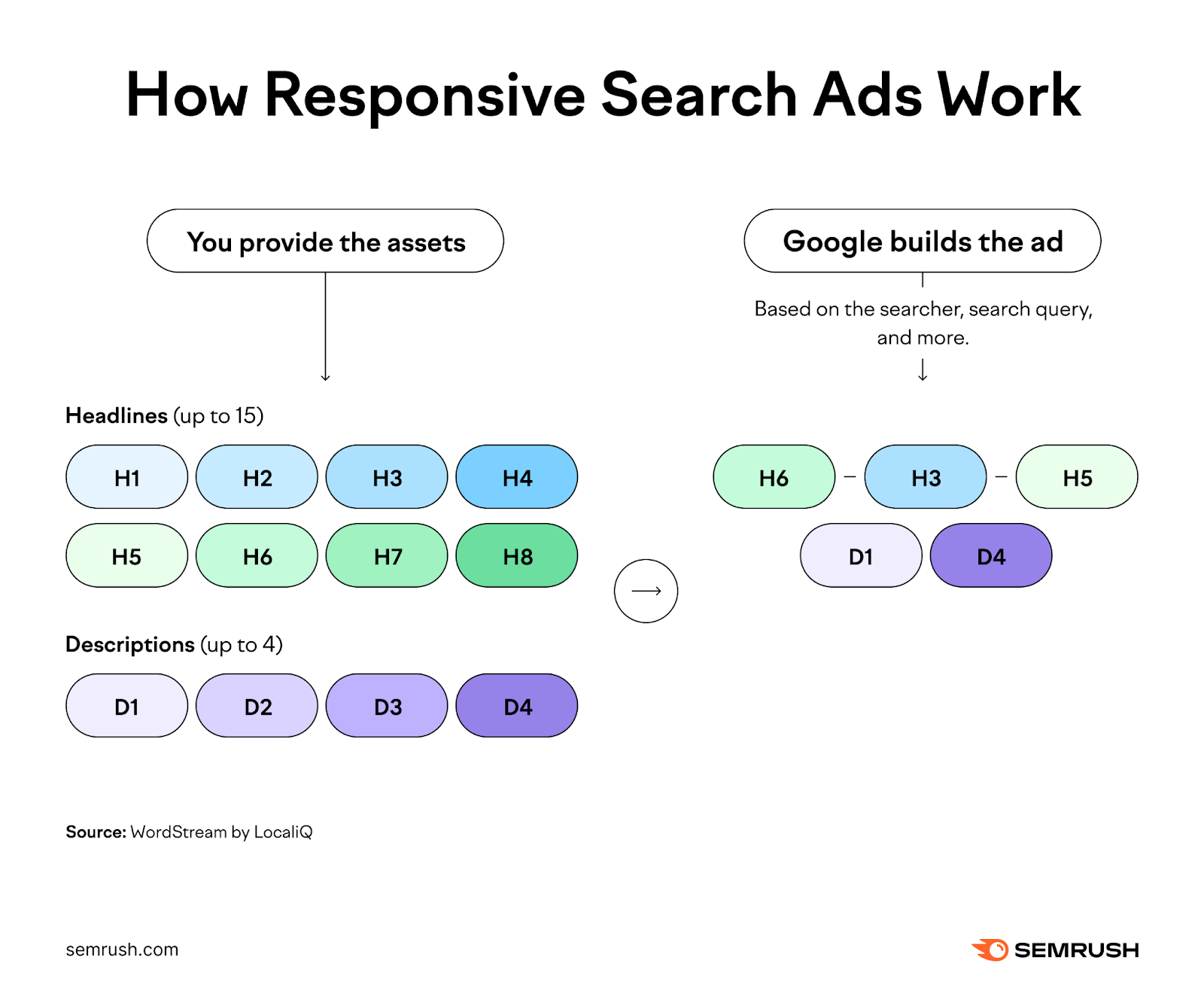
The basic structure remains the same: you provide up to 15 headlines (30 characters each) and 4 descriptions (90 characters each), and Google's algorithm assembles them into combinations to display. Each user sees up to 3 headlines and 2 descriptions. But what happens between your input and the user's screen has become far more sophisticated.
Google's AI now goes beyond simple A/B testing of your provided assets. It considers the specific search query, the user's device, the time of day, their location, their recent browsing behaviour, and competitive dynamics in the auction, all in real time, to determine which combination of your headlines and descriptions to show each individual searcher. Two people typing the same query five minutes apart might see completely different versions of your ad.
But the biggest change arrived with AI Max for Search campaigns, which launched globally in May 2025 and has been expanding throughout late 2025 and into 2026. AI Max introduced text customisation, an upgrade of the former "automatically created assets" feature that fundamentally changes the copy equation.
With text customisation enabled, Google's AI generates additional headlines and descriptions for your responsive search ads using a combination of techniques. It pulls snippets from your landing page titles, meta descriptions, and on-page content. It uses generative AI to synthesise new assets based on your existing ads, keywords, and landing page context. These AI-generated assets then enter the same testing pool as your human-written headlines and descriptions, competing for impressions based on predicted performance.
Google reported that advertisers activating AI Max see an average 14% lift in conversions at similar cost per acquisition. L'Oreal doubled their conversion rate while cutting cost per conversion by 31%. These are not marginal improvements. They represent a genuine step change in how ad copy drives performance.
And there is another shift that caught many advertisers off guard. As of 2025, up to two unused RSA headlines can now serve in the space that previously only sitelinks were eligible for. Google's AI can also omit descriptions entirely if doing so leads to better engagement. The rigid "3 headlines and 2 descriptions" format is no longer guaranteed. Your ad might show as two headlines with no description, or three headlines with one description, depending on what the algorithm predicts will perform best.
Here is a truth that is uncomfortable for anyone who has built a career writing Google Ads copy: with 15 headlines and 4 descriptions creating 43,680 possible combinations, and AI Max generating additional assets on top of that, obsessing over the perfect phrasing of headline number seven is not a productive use of your time.
This is not to say words do not matter. They do, enormously. But the unit of optimisation has changed. You are no longer crafting a single ad. You are building a library of modular assets that need to work in any combination, and the algorithm decides which combinations actually see the light of day.
Think about what this means practically. You write a headline that says "Free Shipping on All Orders." That headline might appear alongside "Shop Our Summer Collection" and "Trusted by 50,000+ Customers." Or it might appear with "Same-Day Delivery Available" and "New Arrivals Just Added." The same headline, in two completely different ad contexts, serving two completely different user intents. And you have no control over which combination appears.
This reality kills the traditional approach to ad copywriting, where you craft a complete narrative across headline 1, headline 2, headline 3, and the description. That narrative only works if the headlines appear in the exact order you intended. With RSAs, they probably will not.
The new approach is to write assets that are independently strong. Each headline should make a complete, compelling point on its own. Each description should stand alone as a persuasive statement, not depend on a specific headline above it. Your assets are Lego bricks, not puzzle pieces. Every brick should be interesting and valuable by itself, and any combination of bricks should build something coherent.
According to research from Adalysis analysing over a million RSAs, ads need at least 8 headlines to achieve "Excellent" ad strength, and the majority of "Excellent" rated ads have 13 or more headlines. But critically, ad strength is not purely about quantity. Google checks for keyword relevance, content diversity, and distinctiveness between headlines. Ads with 15 nearly identical headlines actually score "Poor" because the algorithm cannot find meaningful variation to test.
Despite AI Max's capabilities, there are areas where human input is not just helpful but essential. Understanding these areas is how you ensure your RSAs outperform competitors who hand everything to the algorithm.
Unique value propositions. AI can rephrase, remix, and optimise, but it cannot invent your competitive advantage. If your product is the only one with a patented feature, or your service includes something no competitor offers, that information has to come from you. AI Max generates copy from your landing page and existing ads. If your landing page does not clearly articulate what makes you different, the AI has nothing distinctive to work with. Garbage in, garbage out.
Brand voice and personality. AI-generated headlines tend to be competent but generic. They will accurately describe your product and include relevant calls to action, but they rarely capture the personality that makes a brand memorable. If your brand voice is playful, authoritative, irreverent, or warm, you need to encode that into your human-written assets. Google's text guidelines feature (rolling out to all advertisers in early 2026) helps with this by letting you provide natural language instructions like "use an informal, conversational tone" or "emphasise sustainability." But the guidelines are only as good as the brand voice you define.
Factual accuracy and compliance. Google's text customisation documentation explicitly warns advertisers to ensure their website content is accurate and policy-compliant, because the AI relies heavily on it as source material. If your landing page contains outdated pricing, discontinued promotions, or claims that do not comply with industry regulations, the AI may incorporate that information into your ads. In regulated industries like healthcare, finance, and legal services, human oversight of AI-generated assets is not optional. It is a compliance requirement.
Emotional resonance and storytelling. AI is remarkably good at functional copy: clear descriptions, logical benefit statements, and straightforward calls to action. What it struggles with is the emotional dimension that makes someone feel something when they read your ad. A headline like "Finally, a mattress that doesn't make Monday mornings worse" connects on a human level that "High-Quality Mattresses Available Online" never will. These emotionally resonant headlines often outperform purely functional ones, particularly in competitive markets where multiple advertisers offer similar products.
Strategic messaging decisions. Should you lead with price or value? Should you emphasise urgency or trust? Should you test a promotion-first approach or a benefit-first approach? These are strategic choices that require understanding your market position, competitive landscape, and customer psychology. AI can test which approach performs better once you provide the options, but it cannot make the initial strategic decision about which messaging frameworks to test.
Now let us give AI its due, because the advantages are substantial and growing.
Testing combinations at inhuman scale. A human copywriter might write 15 headlines and 4 descriptions for an RSA, then wait weeks or months to gather enough data to determine which combinations work. Google's algorithm tests 43,680+ possible combinations simultaneously, gathering statistically significant performance data across millions of impressions, and converges on winning combinations far faster than any human testing process. With AI Max generating additional assets, the testing space expands even further.
Real-time adaptation to individual queries. When someone searches "affordable running shoes for beginners," the ideal ad copy is different from when they search "best running shoes for marathon training," even if both queries are in the same ad group. AI can match specific headlines and descriptions to specific query patterns in real time, creating a degree of message relevance that would require thousands of manually written ads to replicate.
Device and context optimisation. Mobile users see fewer headlines (often 2 instead of 3). Users searching at 2am have different intent than users searching at 2pm. Users in different geographic locations respond to different messaging. The algorithm adapts to all of these variables simultaneously, selecting the right combination for each unique context. No human can manage this level of granularity across thousands of keywords.
Cross-query learning. This is perhaps the most underappreciated advantage. When AI Max identifies that a particular headline performs well for a specific type of query, it can apply that learning across your entire account, surfacing similar messaging patterns in other campaigns and ad groups. This cross-pollination of creative insights happens continuously and automatically, creating a compound optimisation effect that accelerates over time.
Landing page alignment. With Final URL Expansion enabled alongside text customisation, AI Max can select the most relevant landing page for each query and then adapt ad copy to match that landing page. This creates a keyword-to-ad-to-landing-page alignment that is nearly impossible to maintain manually across a large account. If you have hundreds of product pages, AI can dynamically match the right ad copy to the right product page for each search, ensuring message consistency throughout the entire click journey.
The performance comparison between AI-generated and human-written RSA assets is more nuanced than either side of the debate acknowledges.
Google's internal data consistently shows positive results from text customisation. The 14% average conversion lift for AI Max adopters is a real number drawn from campaigns with more than 70% of conversions from exact or phrase match keywords. L'Oreal's 2x conversion rate improvement and 31% cost-per-conversion reduction are documented case studies. MyConnect generated 16% more leads at 13% lower cost per lead.
But these results measure the combined effect of AI Max's features, not text customisation in isolation. The conversion lift includes the impact of broader search term matching and Final URL Expansion alongside AI-generated ad copy. Isolating the pure ad copy impact is difficult because the features are designed to work together.
What we can say from industry data is this: RSAs with "Good" or "Excellent" ad strength, which typically requires diverse, keyword-relevant headlines including a mix of human-written and AI-generated assets, consistently outperform those with "Poor" or "Average" ad strength. Each step up in ad strength correlates with approximately a 3% improvement in click-through rate. Accounts with two RSAs per ad group tend to see the best conversion rates, outperforming both single-RSA and three-RSA setups.
The honest truth is that AI-generated copy performs best when it has strong human inputs to build upon. Accounts where advertisers provide thoughtful, strategically diverse human-written headlines and descriptions, and then let AI Max supplement and optimise, outperform both accounts that rely entirely on AI and accounts that try to manually control everything through heavy pinning.
The research from Optmyzr and Adalysis supports this. Pinning one headline can reduce your testing potential by up to 75%. Heavy pinning virtually eliminates the possibility of achieving "Excellent" ad strength. The advertisers who perform best are those who write strong base assets, provide strategic direction through text guidelines, and then let the algorithm do what algorithms do best: test and optimise at scale.
Here is a practical framework for writing RSA assets that maximises performance in the AI Max era. This approach treats your human-written headlines and descriptions as strategic inputs that guide AI optimisation, rather than finished products that must appear exactly as written.
Start with five headline categories. For each RSA, write headlines that cover these five angles: keyword-centric headlines that mirror how users actually search (these tend to get bolded when they match the query), unique value proposition headlines that communicate what makes you different, social proof headlines featuring specific numbers (reviews, customers, years in business), call-to-action headlines that tell users exactly what to do next, and benefit-focused headlines that speak to what the customer gets, not what you offer. Write at least two headlines per category, giving you 10 or more headlines with genuine strategic diversity.
Write descriptions that stand independently. Your descriptions should each be a complete, persuasive statement. One description might focus on your core offering with a CTA. Another might emphasise a current promotion or guarantee. A third might address common objections or concerns. None should depend on a specific headline appearing above it.
Provide enough raw material for AI Max. With text customisation enabled, Google's AI will supplement your headlines and descriptions with additional assets drawn from your landing pages and existing ads. But the AI's output is only as good as the content it draws from. Ensure your landing pages have clear, compelling, accurate copy that reflects your current offerings, pricing, and differentiators. The AI will find and use this content.
Set text guidelines to maintain brand integrity. If there are terms you never want in your ads ("cheap," "budget," "discount" for a premium brand), exclude them through text guidelines. If you want specific messaging themes emphasised ("sustainability," "innovation," "family-owned"), specify that through natural language instructions. This is your steering wheel for AI-generated content.
Review and remove, but resist the urge to over-control. Once AI Max generates additional assets, review them for accuracy and brand alignment. Remove anything that is factually wrong, off-brand, or policy-noncompliant. But resist the temptation to remove assets simply because you would not have written them that way. The algorithm may discover that a headline you would never have written outperforms your carefully crafted favourite. Let the data decide.
Refresh every 4 to 6 weeks. Even with AI optimisation, creative fatigue is real. Introduce new human-written headlines every month or two to give the algorithm fresh material. Remove assets that have accumulated enough data to be labelled "Low" performance. This creates a continuous improvement cycle where your asset library gets stronger over time.
Here is what most discussions about ad copy miss entirely: your headline does not convert. Your headline gets a click. The conversion happens downstream, on your landing page, through your checkout process, during the phone call with your sales team. Ad copy is one link in a chain, and optimising it in isolation is like tuning one cylinder of an engine while ignoring the other five.
The real performance unlock in 2026 is not better ad copy or smarter AI-generated headlines. It is optimising the entire chain, from keyword to ad copy to landing page to conversion action, as one integrated system. When your ad promises "Free Consultation Within 24 Hours" but your landing page does not mention consultations, you have a message match problem that kills conversion rate no matter how brilliant your headline is.
This is where autonomous AI management creates an advantage that neither human copywriters nor Google's built-in AI can match on their own.
groas optimises the full conversion pipeline as a single, coordinated system. Its AI agents do not just write and test ad copy. They analyse which keyword-to-ad-to-landing-page combinations produce actual conversions, and they adjust all three elements together. If a specific headline consistently drives clicks that do not convert on a particular landing page, groas identifies the mismatch and either adjusts the ad copy, shifts the traffic to a different landing page through Final URL Expansion, or modifies the bidding for that keyword-ad combination.
This pipeline-level optimisation is something that cannot be done manually at scale. A human can look at a campaign's overall conversion rate and make broad adjustments. But identifying that headline #7 paired with landing page /product-x converts at 8% while the same headline paired with landing page /category-y converts at 1.2%, across thousands of keyword-ad-page combinations, requires the kind of continuous, granular analysis that only autonomous AI can perform.
groas also leverages AI Max's text customisation and Final URL Expansion as integrated tools within its broader optimisation framework. Where Google's AI optimises within the bounds of a single campaign's settings, groas coordinates across your entire account, ensuring that ad copy learnings from one campaign inform creative strategy in others, and that landing page performance data feeds back into ad copy decisions.
The result is a system where every piece of your advertising, from the keyword that triggers the ad, to the headline that earns the click, to the landing page that closes the conversion, is continuously improving as one interconnected machine.
The shift from human-crafted ad copy to AI-augmented responsive search ads does not make your role less important. It makes it different. You are moving from execution to direction. From writing the perfect headline to building the strategic framework that makes perfect headlines possible.
Your job in 2026 is to define what makes your business different. To articulate your value proposition with clarity and conviction. To understand your customer's psychology well enough to provide the emotional and strategic raw material that AI cannot generate from a landing page scan. And to set the boundaries and guidelines that keep AI-generated content on-brand, accurate, and compliant.
Everything else, the testing, the combination optimisation, the real-time adaptation, the cross-query learning, the device-level adjustment, the landing page matching, is better handled by machines. Not because machines are smarter, but because the scale of the problem has outgrown human capacity.
groas was built for exactly this reality. You bring the strategy, the brand knowledge, and the business context. groas handles the relentless, data-intensive work of turning those inputs into high-converting ad campaigns across thousands of keyword and query combinations. It is not replacing your expertise. It is amplifying it across every ad, every keyword, and every landing page in your account, 24 hours a day.
Google allows up to 15 headlines and 4 descriptions per RSA, with a minimum of 3 headlines and 2 descriptions to serve. Research shows that RSAs need at least 8 headlines to achieve "Excellent" ad strength, and the majority of top-performing RSAs have 13 or more. Aim for at least 10 diverse headlines covering different messaging angles: keyword-centric, value proposition, social proof, calls to action, and benefit-focused. Quality and diversity matter more than quantity. Fifteen nearly identical headlines score worse than eight genuinely distinct ones.
Ad strength is a diagnostic indicator, not a direct ranking factor. Google states it measures how well your RSA follows best practices. However, industry data shows each step up in ad strength (Poor to Average, Average to Good, Good to Excellent) correlates with approximately a 3% improvement in click-through rate. Ads with "Poor" ad strength can still outperform in specific situations, but on average, pursuing "Good" or "Excellent" ratings is worthwhile. Importantly, ad strength is not a performance metric. It does not reflect your actual CTR or conversion rate.
Use pinning sparingly. Research shows that pinning one headline can reduce your testing potential by up to 75%, and heavily pinned RSAs almost never achieve "Excellent" ad strength. Only pin when you have a genuine business requirement: legal disclaimers, brand name visibility, or compliance messaging. If you must pin, pin 2 to 3 headlines to the same position so the algorithm retains some testing flexibility. For most advertisers, writing strong standalone headlines and letting the algorithm decide placement produces better results.
Text customisation is a feature within AI Max for Search campaigns that generates additional RSA headlines and descriptions using AI, drawing from your landing pages, existing ads, and keywords. It was formerly known as "automatically created assets." Advertisers using AI Max see an average 14% conversion lift at similar CPA according to Google's data. Most advertisers should enable it, but with two caveats: ensure your website content is accurate and policy-compliant (the AI uses it as source material), and review AI-generated assets regularly for brand alignment and factual accuracy.
Text guidelines, rolling out to all advertisers in early 2026, let you steer AI-generated copy using natural language instructions. You can exclude specific terms (e.g., "never use the word cheap") and provide messaging direction (e.g., "emphasise sustainability and environmental benefits" or "avoid making medical claims"). This gives you brand control over AI-generated content without restricting the algorithm's ability to test and optimise. Text guidelines are set at the campaign level and apply to all AI-generated assets within that campaign.
Establish a creative refresh cadence of every 4 to 6 weeks for RSA assets. At each refresh, review asset-level performance data, remove low-performing headlines and descriptions, and introduce 3 to 5 new assets with different messaging angles. Even with AI Max generating additional assets, your human-written inputs set the strategic direction, and fresh inputs give the algorithm new material to test against. Accounts that never refresh their RSAs consistently see declining click-through rates over time due to creative fatigue.
In many cases, yes, particularly for functional, query-matching copy. AI excels at generating headlines that mirror specific search terms, adapt to device contexts, and optimise for click-through rate at scale. However, the best-performing RSAs combine human-written assets (providing unique value propositions, brand voice, and emotional resonance) with AI-generated assets (providing scale, adaptation, and continuous testing). Neither approach alone produces optimal results. The winning strategy is collaborative: humans set the strategic direction, AI handles the execution and optimisation.
Google's AI Max optimises ad copy within individual campaigns. groas optimises across your entire account and across the full conversion pipeline: keyword, ad copy, and landing page together. Where Google's AI tests headline combinations, groas analyses which keyword-ad-landing page combinations produce actual conversions and adjusts all three elements in coordination. This pipeline-level optimisation identifies and fixes message match problems, creative fatigue, and conversion bottlenecks that campaign-level AI cannot detect. groas also applies learnings from one campaign to inform creative strategy across your entire account.