Autonomous Google Ads: The End of the PPC Agency Model?
Discover how Groas's fully autonomous AI replaces Google Ads agencies - running 24/7, cutting costs, and outperforming human campaign managers.
March 22, 2026
•
5
min read

Last Updated: February 2026
Let us get this out of the way upfront: Adalysis is a good product. It is a genuinely useful PPC management tool built by people who clearly understand the craft of Google Ads. If you are a serious PPC professional who prides yourself on running tight campaigns, Adalysis gives you capabilities that Google's native interface does not, particularly around ad testing, quality score analysis, and account auditing.
But "good product" and "right product for you" are two different questions. And in 2026, the PPC landscape has shifted enough that the answer to the second question depends heavily on what you actually want from your Google Ads management stack.
This review covers what Adalysis does well, where it falls short, who it is genuinely built for, who should look elsewhere, and how it compares to autonomous AI alternatives like groas. If you are researching Adalysis pricing, evaluating Adalysis alternatives, or trying to decide whether upgrading your toolkit is worth the investment, this is the honest breakdown.
Adalysis has built a loyal following among PPC professionals for good reasons. The platform excels in several areas that matter deeply to people who manage Google Ads campaigns hands-on every day.
Ad testing is Adalysis's crown jewel. This is the feature that put Adalysis on the map and remains its strongest differentiator. The platform automates the creation and management of A/B tests across multiple ad groups simultaneously, something that is tedious and error-prone when done manually in Google Ads. You can test ad variations using different labels, patterns, and templates, and Adalysis provides clear statistical analysis showing which variations are winning and why. For agencies managing dozens or hundreds of ad groups across multiple accounts, this capability alone can save hours of manual work per week.
What makes Adalysis's ad testing superior to what you can do natively in Google Ads is the multi-ad-group perspective. Google's interface shows you ad-level performance within a single ad group. Adalysis aggregates patterns across your entire account, surfacing insights like "headlines mentioning free shipping outperform price-focused headlines across 78% of your ad groups." That kind of cross-account creative intelligence is genuinely difficult to replicate manually.
Quality Score monitoring is deep and actionable. Adalysis provides detailed breakdowns of Quality Score components (expected CTR, ad relevance, landing page experience) at a granularity that Google's interface does not easily surface. It tracks Quality Score changes over time, correlates them with campaign performance, and alerts you when scores drop for high-value keywords. For PPC managers who understand that Quality Score directly impacts cost per click, this monitoring provides an early warning system for cost problems before they show up in your spending.
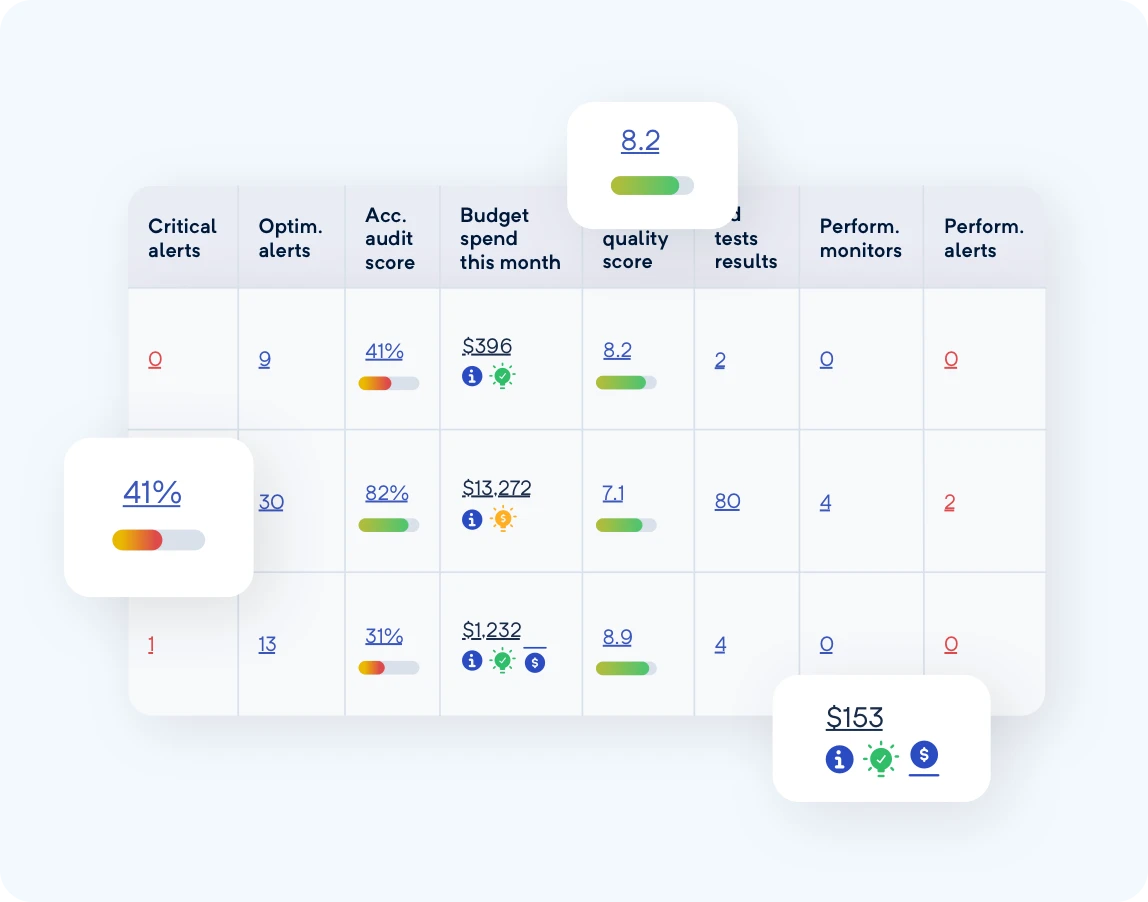
The automated audit engine is genuinely comprehensive. Adalysis runs over 100 automated checks on your account daily, scanning for issues like duplicate keywords, keyword conflicts, ad groups without active ads, low Quality Score clusters, budget pacing problems, and negative keyword gaps. These checks surface the kind of small, persistent issues that slowly erode performance in large accounts. One review on Capterra noted that the audit engine helped them "detect small errors and optimization opportunities that I normally wouldn't notice in my day-to-day management," which is a fair summary of its value.
Budget management and pacing tools are solid. Adalysis includes budget tracking, forecasting, and automated spending alerts that help agencies manage the perennial challenge of keeping campaigns on budget across dozens of client accounts. One agency reported gaining "100% control over budget overspending, with around 5,000 ongoing client projects." For agencies where budget overruns directly damage client relationships, this is not a trivial feature.
N-gram analysis and keyword tools go beyond the basics. Adalysis offers n-gram analysis (identifying patterns in search terms at the word and phrase level), duplicate keyword detection, keyword conflict reporting, and query analysis tools that are genuinely useful for large-account optimisation. These are the kind of features that save a senior PPC analyst an hour of spreadsheet work every time they would otherwise need to do the analysis manually.
Reporting is practical and agency-friendly. With 50 pre-built templates, white-label options, and integration with Google Data Studio and Sheets, Adalysis provides the kind of client-facing reporting that agencies need without requiring custom development.
Adalysis's strengths are real, but so are its limitations. And several of those limitations have become more significant as the Google Ads ecosystem has evolved.
Adalysis identifies problems. It rarely fixes them. This is the fundamental constraint of Adalysis's architecture: it is an analytics and recommendations platform, not an execution platform. It will tell you that your Quality Score dropped on a high-value keyword. It will flag that certain ad variations are underperforming. It will alert you that budget is pacing ahead of schedule. But in most cases, you still need to go into Google Ads and make the changes yourself. The platform offers some one-click actions for simpler fixes, but the strategic decisions, the ones that actually move performance, still require a human.
In 2023, this was fine. The expectation was that a skilled human would interpret recommendations and act on them. In 2026, with AI Max for Search generating ad copy automatically, Smart Bidding handling bid adjustments, and Performance Max managing cross-channel allocation, the "recommendations that a human must execute" model feels increasingly like adding a step to a process that could be fully automated.
The interface feels dated. Multiple user reviews on Capterra and Software Advice mention this. Comments like "a bit outdated compared to today's PPC landscape," "the UI and UX was a bit lackluster and made being in the platform a chore," and "needs more polish to 2025 standards" suggest that while the underlying functionality is strong, the experience of using Adalysis daily has not kept pace with modern SaaS design standards. For a tool you are expected to use every day, interface friction matters. It slows down workflows and increases the cognitive load on already-busy PPC managers.
Dashboard updates are not real-time. The Adalysis dashboard updates every 24 hours. Several reviewers flagged this as a limitation, noting they wished for updates every 1 to 2 hours so that changes made in Google Ads would reflect more quickly. In a landscape where bid adjustments and competitive dynamics can shift hourly, daily dashboard updates mean you are always working with slightly stale data.
There is a meaningful learning curve. Despite its reputation among PPC experts, Adalysis is not immediately intuitive. Reviews consistently note that the platform is "overwhelming in the beginning" and that "many features are not being utilized" because users have not invested the time to learn them. One reviewer admitted the platform was "a bit of a learning curve for me, which I didn't dedicate enough time to figuring out." For agencies onboarding new team members, this learning curve represents a real cost in productivity.
Limited AI and automation capabilities. This is perhaps the most significant gap as of 2026. Adalysis does not natively integrate with Google's AI Max for Search features. It does not autonomously generate ad copy, manage text customisation settings, or leverage Final URL Expansion. It does not automatically adjust bidding strategies based on conversion data accumulation. It provides information and recommendations. The human in the loop must decide what to do with them.
When Google itself is building increasingly sophisticated AI into the ads platform (AI Max delivers an average 14% conversion lift for adopters), a third-party tool that does not engage with these AI capabilities is fighting with one hand tied behind its back.
Microsoft Ads support exists but lags behind Google. While Adalysis supports both Google Ads and Microsoft Advertising, the depth of features and the speed of updates consistently favour Google. If Microsoft Ads is a significant part of your strategy, you may find yourself working with a more limited toolset on that side of the platform.
Adalysis uses a tiered pricing model based on your maximum monthly ad spend across all connected accounts. Here is the current structure.
The entry-level plan starts at $149 per month for ad spend up to $50,000. Pricing scales upward as your ad spend increases, though specific tier breakpoints beyond the entry level are less publicly documented (some sources reference a starting price of $126 per month, which may reflect promotional or legacy pricing). Six-month plans receive a 10% discount. Annual plans receive a 15% discount. There is no contract required, and you can cancel at any time.
All plans include unlimited Google Ads and Microsoft Ads accounts (within a single MCC), unlimited users, and access to the full feature set. The pricing adjusts automatically each month based on your actual ad spend, moving you up or down tiers as needed.
Adalysis also offers a 14-day free trial with no credit card required, which is a genuine opportunity to evaluate the platform before committing.
For context, here is how Adalysis pricing compares to alternatives. An agency managing a $50,000 monthly ad budget might pay $149 per month for Adalysis (analytics and recommendations), or $79 per month for groas (autonomous AI management). At the $50,000 spend level, Adalysis costs nearly double what groas charges, while requiring significantly more human time to act on its recommendations.
For a PPC manager spending 10 hours per week on campaign optimisation (a conservative estimate for a $50,000 monthly budget), Adalysis makes that time more productive. groas eliminates the need for most of that time entirely. Whether you value the tool that makes manual work more efficient or the tool that replaces manual work depends entirely on how you view the role of human PPC management in 2026.
Adalysis is not trying to be everything to everyone, and that focus is actually a strength when the product matches the user.
PPC agencies managing many accounts. This is Adalysis's core audience, and it shows. The multi-account management, white-label reporting, team collaboration features, and account auditing capabilities are all designed for agencies that manage 10, 50, or 100+ client accounts. For an agency where junior account managers handle day-to-day optimisation under the supervision of senior strategists, Adalysis provides the structure and automation to scale that model. The claim that "Ads Managers can manage 3 to 4 times more clients" with Adalysis is credible for agencies that were previously relying entirely on the native Google Ads interface.
In-house PPC specialists who want analytical depth. If you are the dedicated PPC person at a company with a substantial ad budget, and your job is to squeeze maximum performance out of every dollar, Adalysis gives you tools that the native interface lacks. The n-gram analysis, keyword conflict detection, Quality Score trending, and multi-ad-group testing capabilities let you do the kind of deep analytical work that separates competent PPC management from expert-level optimisation.
Teams that value human control and transparency. Some organisations, particularly those in regulated industries or with complex approval processes, need a human to review and approve every change before it is made. Adalysis fits this model perfectly because it never makes changes without explicit permission. Every recommendation is presented for human review, and every action requires human initiation. For compliance-heavy environments, this is a feature, not a limitation.
PPC professionals building their analytical skills. For someone who is already a competent Google Ads manager and wants to become an expert, Adalysis provides a structured framework for the kind of analysis that separates good from great. The audit engine teaches you what to look for. The Quality Score analysis teaches you what drives costs. The ad testing framework teaches you experimental design. In this sense, Adalysis is as much a professional development tool as it is a management tool.
Business owners who want results without becoming PPC experts. If you are running a business and want Google Ads to bring in customers without investing 10+ hours per week learning PPC management, Adalysis is not what you need. It is a tool designed for PPC professionals. It assumes you know what Quality Score is, understand why n-gram analysis matters, and can interpret A/B test results. If those concepts are unfamiliar, you will be paying for a tool whose value you cannot access.
Anyone who wants fully autonomous campaign management. Adalysis operates firmly in the "better recommendations for human operators" category. It does not create campaigns. It does not write ad copy. It does not adjust bids autonomously. It does not manage negative keywords in real time. It does not optimise the keyword-to-ad-to-landing-page pipeline as an integrated system. If you want AI that handles execution, not just analysis, Adalysis is architecturally the wrong tool.
Small businesses with limited budgets. At $149 per month for the entry-level plan (designed for up to $50,000 in monthly ad spend), Adalysis is priced for established advertisers. If your monthly ad budget is $2,000 to $5,000, paying $149 per month for an analytics layer on top of that spend represents a significant percentage of your total investment, and the analytical depth Adalysis provides is most valuable at scale, where the complexity justifies the tooling.
Teams that want AI Max and Performance Max integration. If you are leaning into Google's AI-powered features (and in 2026, you should be), Adalysis does not provide native integration with AI Max text customisation, Final URL Expansion, or the enhanced reporting these features offer. It works alongside these features but does not leverage them directly.
Comparing Adalysis to groas is not really an apples-to-apples comparison, because the two tools are built on fundamentally different philosophies about how PPC management should work. Understanding this distinction is more important than comparing feature checklists.
Adalysis operates on the "better pilot" philosophy. It assumes a skilled human is flying the plane and provides that human with better instruments, better data, and better situational awareness. The value proposition is: you are already good at PPC, and Adalysis makes you better by surfacing insights faster, automating tedious analysis, and keeping you informed about issues you might otherwise miss. The human makes every decision. Adalysis makes those decisions better-informed.
groas operates on the "autopilot" philosophy. It does not assume a skilled human is in the loop for day-to-day operations. Its AI agents make optimisation decisions autonomously, around the clock, across every dimension of campaign management simultaneously. The value proposition is: your strategic thinking is valuable, but the 10+ hours per week you spend on operational PPC management is not the best use of that thinking. Let AI handle the execution while you focus on strategy, creative direction, and business growth.
The practical differences between these philosophies are significant.
When Adalysis detects that a keyword's Quality Score has dropped, it alerts you and provides diagnostic data. You then need to investigate the cause, decide on a fix, implement the fix in Google Ads, and monitor whether it worked. Elapsed time from detection to resolution: hours to days, depending on your schedule.
When groas detects the same Quality Score drop, its AI agents automatically diagnose the cause, adjust the relevant factors (ad copy relevance, landing page routing via Final URL Expansion, bid adjustments), and monitor the impact. Elapsed time from detection to resolution: minutes to hours, with no human intervention required.
When Adalysis identifies winning ad copy variations through its testing framework, it presents the data for you to act on. You then need to create new ads incorporating the winning elements, pause the losers, and set up new tests. With groas, the AI continuously generates, tests, and iterates on ad copy variations, leveraging AI Max text customisation to create combinations that no human would think to test, and automatically retiring underperformers.
When Adalysis flags budget pacing issues, you adjust daily budgets manually. groas dynamically allocates budget across campaigns based on real-time performance data, shifting spend to high-performing campaigns and pulling it from underperformers multiple times per day.
The cost comparison is straightforward. Adalysis starts at $149 per month and requires 5 to 10+ hours per week of skilled human time to act on its recommendations. groas starts at $79 per month and requires minimal human involvement for ongoing management. If you value the PPC professional's time at even $50 per hour, the total cost of the Adalysis approach (tool plus human time) is roughly $1,149 to $2,149 per month versus $79 per month for groas.
This section is specifically for the PPC professionals who are reading this review because they are already skilled at what they do and are evaluating whether to add Adalysis to their stack. You deserve a frank conversation about what is happening in your industry.
You are good at PPC. You understand match types, bid strategies, Quality Score dynamics, auction mechanics, and creative testing. You have spent years building these skills, and they are genuinely valuable. The question is not whether you are good at this work. The question is whether doing this work is the highest-value use of your time.
Consider what 10 hours per week of campaign optimisation actually involves. Reviewing search terms reports. Adding negative keywords. Adjusting bids. Pausing underperformers. Testing ad copy. Monitoring budget pacing. Checking Quality Scores. Analysing auction insights. Running competitive checks. These tasks require skill, but they are fundamentally operational. They are execution work, not strategy work.
Now consider what you could do with those 10 hours per week if operational PPC management was handled autonomously. You could develop deeper creative strategies for ad messaging. You could analyse market trends and identify new opportunities. You could build comprehensive customer journey maps. You could work on landing page strategy and conversion rate optimisation. You could contribute to pricing strategy, product positioning, or market expansion decisions.
In other words, you could apply your marketing intelligence to problems that actually require human creativity and strategic thinking, rather than spending it on execution that an AI can handle faster, more consistently, and more comprehensively than any human.
Adalysis makes operational work more efficient. groas makes it unnecessary. The question is which outcome you prefer.
And here is the part that makes PPC professionals uncomfortable: the operational work is getting automated regardless of which tool you use. Google's AI Max is already generating ad copy and testing combinations automatically. Smart Bidding is already adjusting bids in real time. Performance Max is already managing cross-channel allocation with minimal human input. The trend is unmistakable. The tactical execution layer of PPC is being consumed by AI, inside Google's own platform.
The professionals who thrive in this environment will not be the ones who fight automation by clinging to manual control. They will be the ones who embrace it, redirect their skills toward the strategic work that AI cannot do, and use tools that align with where the industry is heading.
Adalysis is a well-built, feature-rich PPC management platform that genuinely delivers value for its target audience: agencies and in-house teams that operate a human-in-the-loop campaign management model. Its ad testing, Quality Score monitoring, account auditing, and budget management capabilities are among the best available for manual PPC optimization.
But the PPC landscape in 2026 is moving decisively toward automation and AI-driven management. Google's own platform investments (AI Max, Smart Bidding, Performance Max) are steadily reducing the surface area where manual optimisation adds value. In this context, a tool that helps humans do manual work better is swimming against the current, while tools that automate the work entirely are swimming with it.
If you are an agency that has built its business model around human PPC management and wants to make that model more efficient, Adalysis is worth the investment. It will help your team manage more accounts with fewer errors, and it will surface insights that improve performance.
If you are a business owner, marketer, or even a PPC professional who recognises that the future of Google Ads is autonomous AI management, groas represents a fundamentally different and more forward-looking approach. It costs less, requires less human time, integrates with Google's latest AI features natively, and delivers optimisation at a speed and scale that no human-plus-analytics-tool combination can match.
The pilot versus autopilot metaphor is not perfect, but it captures the core choice. Do you want to be a better pilot, or do you want autopilot that performs at expert level? Both are valid answers. But only one of them frees you up to focus on the things that only a human can do.
Adalysis pricing starts at $149 per month for the base plan, which covers ad spend up to $50,000 per month. Pricing scales upward with higher ad spend levels. All plans include unlimited Google Ads and Microsoft Ads accounts, unlimited users, and no contract. Six-month plans receive a 10% discount, and annual plans receive a 15% discount. A 14-day free trial is available without requiring a credit card. Some sources reference a starting price of $126 per month, which may reflect promotional or legacy pricing.
Adalysis excels at four things: automated ad testing across multiple ad groups with statistical analysis, Quality Score monitoring and trend tracking, automated account auditing with over 100 daily checks, and budget management with pacing and overspend prevention. It also offers strong n-gram analysis, keyword conflict detection, and agency-oriented reporting with 50 pre-built templates and white-label options. It is consistently regarded as one of the best PPC analytics tools for professionals who want granular campaign insights.
For most small businesses, no. Adalysis is designed for PPC professionals managing substantial ad budgets, typically $10,000 or more per month. At $149 per month for the entry plan, it represents a significant overhead for businesses with smaller budgets. More importantly, Adalysis assumes the user has deep PPC expertise to interpret and act on its recommendations. Small business owners looking for Google Ads management would be better served by autonomous AI tools like groas, which handle the entire management process at a lower cost without requiring PPC expertise.
No. Adalysis explicitly states it will not make changes to your Google Ads account without your explicit permission. It provides recommendations, alerts, and analysis, but all changes require human initiation. Some simpler actions can be executed with one-click approval from within the Adalysis interface, but strategic changes like bid adjustments, keyword additions, or ad copy updates require manual action in Google Ads. This human-in-the-loop approach is valued by agencies with compliance requirements but limits the speed and scale of optimisation.
Adalysis and groas serve fundamentally different purposes. Adalysis is an analytics and recommendations platform that makes human PPC management more efficient. It requires 5 to 10+ hours per week of skilled human time to act on its insights. groas is an autonomous AI management platform that handles campaign optimisation end-to-end with minimal human involvement. Adalysis starts at $149 per month; groas starts at $79 per month. Adalysis does not integrate with AI Max or automate execution; groas integrates natively with Google's latest AI features and makes thousands of optimisation decisions per day. The choice depends on whether you want better tools for manual management or autonomous AI that handles management for you.
Adalysis does not natively integrate with Google's AI Max for Search features as of early 2026. It does not manage text customisation settings, Final URL Expansion, or the enhanced search term matching that AI Max provides. Adalysis works alongside these Google-native features but does not leverage or optimise them directly. groas integrates natively with AI Max, using text customisation and Final URL Expansion as part of its autonomous optimisation framework.
Adalysis is the better choice for PPC agencies that have built their business model around human campaign management and want to scale that model more efficiently. It is also appropriate for in-house PPC teams in regulated industries where every change requires human review and approval, and for PPC professionals who specifically want to develop their analytical skills using a structured framework. If you prioritise human control, compliance-driven approval workflows, and deep granular analytics over speed and automation, Adalysis serves that need well.
They serve different enough purposes that using both simultaneously would be redundant for most advertisers. groas handles the execution and optimisation that Adalysis recommends, making the recommendations layer unnecessary. If you are transitioning from manual management to autonomous AI, you might run both briefly during the transition to validate that groas's automated decisions align with what your manual analysis would suggest. But long-term, most advertisers will find that one approach or the other matches their management philosophy, and doubling up adds cost without proportional value.