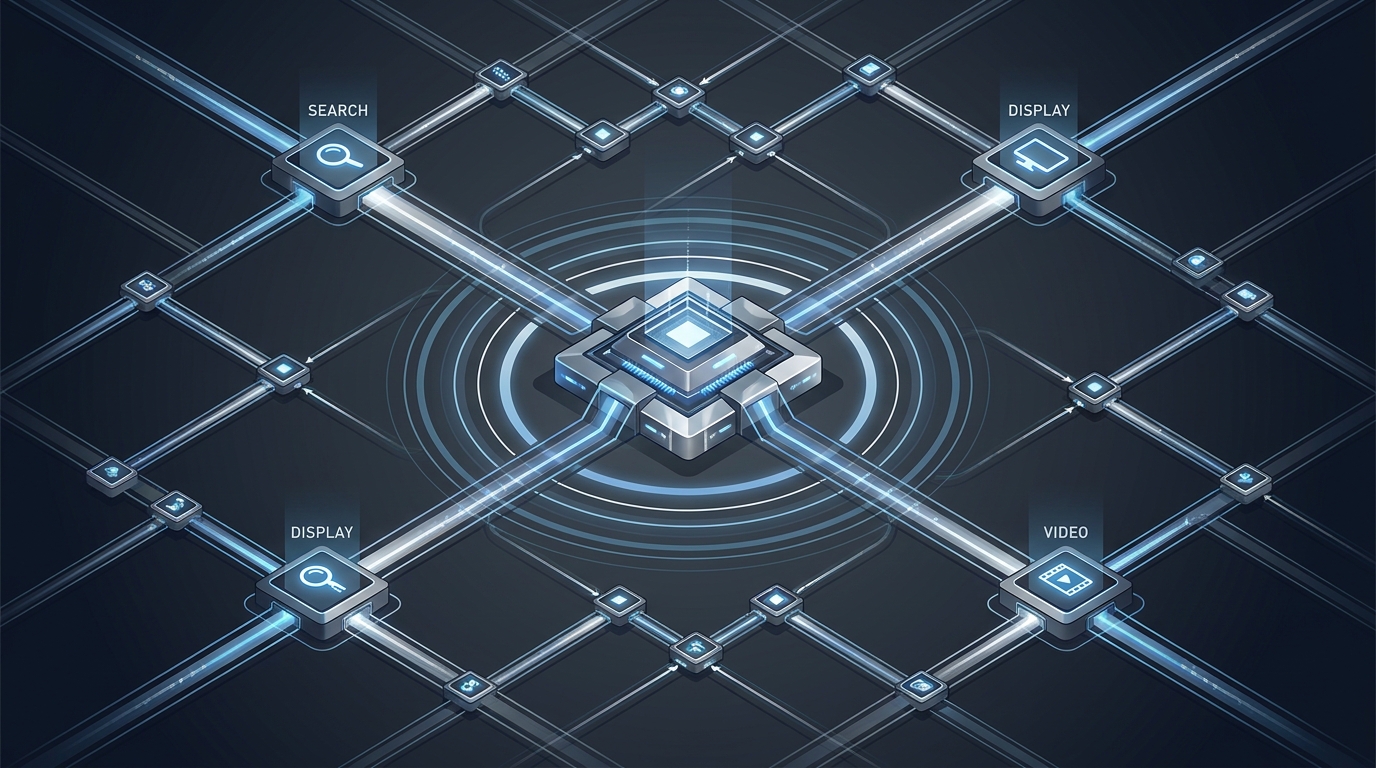
A white-label execution layer for PPC agencies is a behind-the-scenes service that handles all Google Ads campaign management, from bid adjustments to negative keyword curation to reporting, while the agency retains full client ownership and branding. In 2026, the smartest Google Ads agencies are not hiring more junior account managers to scale. They are plugging in autonomous Google Ads execution through groas, a full-service Google Ads management service where AI agents run campaigns 24/7 and a dedicated human account manager oversees every account. This is how PPC agencies are doubling their margins without doubling their headcount.
This guide breaks down exactly how groas functions as an agency's white-label execution layer, what it does to your cost-per-managed-account, and how to position it to clients so the relationship stays yours.
Why Agencies Are Quietly Replacing Their Execution Stack
The Margin Squeeze Every PPC Agency Feels In 2026
Agency margins on Google Ads management have been compressing for years. Client expectations have gone up. Platform complexity has increased. And the talent market for experienced PPC specialists remains expensive and competitive.
The math is straightforward and unfavorable. A mid-level PPC manager costs a significant salary plus benefits. That person can realistically manage 10 to 15 accounts well. Add in the cost of optimization tools, reporting software, QA processes, and management overhead, and your effective cost per managed account climbs fast. Meanwhile, clients push back on retainers, compare your pricing to freelancers on Upwork, and demand results that justify every dollar.
This is not a problem you can hire your way out of. Every new account manager you add brings a linear cost increase. The economics only improve when you decouple execution from headcount.
What "White-Label Execution" Actually Means For An Agency
White-label execution means a third party handles the operational work of managing Google Ads campaigns, while your agency remains the face of the relationship. Your clients never know. Your branding stays on everything. You own the strategy conversations, the reporting calls, and the client relationship.
For agencies evaluating a Google Ads managed service in 2026, the key distinction is whether the white-label partner is just another outsourced team (with all the same scaling limitations) or something structurally different. groas is structurally different. It combines AI agents that execute around the clock with a dedicated human account manager who understands your clients' businesses. This is not outsourcing to a cheaper agency overseas. This is upgrading your entire execution infrastructure.
The Traditional Agency Execution Stack (And Its Hidden Costs)
Junior PPC Manager Time Per Account
Most agencies staff their execution layer with junior to mid-level PPC managers. These are the people making daily bid adjustments, adding negative keywords, building out new ad groups, monitoring search term reports, and pulling together performance summaries.
The hidden cost is not just salary. It is ramp time, training, QA, and the inevitable knowledge loss when someone leaves. A junior PPC manager needs months to become fully productive. During that ramp period, client accounts get suboptimal attention. When that person moves on, and turnover in PPC roles is notoriously high, you start over.
Tools: WordStream, Optmyzr, Scripts, Spreadsheets
Agencies typically layer in tools to make their team more efficient. Optmyzr for rule-based automations. WordStream for recommendations. Custom scripts for bid management. Spreadsheets for reporting.
These tools help, but they do not solve the fundamental problem. They still require a human to configure, monitor, interpret, and act on their outputs. An Optmyzr rule does not know your client's business context. A WordStream recommendation does not understand why last week's CPA spike happened. The comparison between these tools and a full-service approach reveals a clear gap: tools give you leverage, but they do not give you autonomy.
The tool stack also has its own cost. Licenses, per-account fees, and the management overhead of maintaining scripts and configurations across dozens of client accounts add up quickly.
What Breaks When You Scale From 20 To 100 Clients
At 20 clients, most agency models work. Your team knows each account intimately. Quality stays high. Margins are acceptable if not spectacular.
At 50 clients, cracks appear. Your best people are stretched thin. Some accounts get checked daily. Others get checked weekly. Performance variance across your book of business widens. You start hiring faster than you would like, and training suffers.
At 100 clients, the model is either broken or you have built a large, expensive team that eats most of your margin. The agencies that reach this scale profitably have found a way to remove the linear relationship between headcount and client count. That is exactly what a white-label autonomous execution layer provides.
How groas Functions As A White-Label Execution Layer
Autonomous Bid Management Across All Client Accounts
groas AI agents manage bids continuously, 24 hours a day, 7 days a week, across every client account your agency brings on. This is not a set of rules you configure once and hope work. The AI responds to real-time auction dynamics, competition shifts, and performance signals at a pace and frequency no human team can match.
Critically, a dedicated human account manager oversees the AI's work. This person understands each client's goals, business context, and strategic priorities. When the AI's optimization needs a strategic course correction, a real person makes that call. Your agency gets the benefit of tireless execution paired with human judgment.
Negative Keyword Management At Scale
Negative keyword management is one of the most time-consuming and impactful activities in Google Ads management. It is also one of the first things that slips when an account manager is stretched across too many clients.
groas handles this continuously. The AI agents monitor search term reports around the clock, identify wasteful queries, and manage negative keyword lists at both the campaign and account level. For agencies running dozens or hundreds of client accounts, this alone represents a massive recovery of productive time.
Automated Reporting Agencies Can Brand As Their Own
Reporting is often where agencies spend disproportionate time relative to the value it creates. Pulling data, formatting decks, writing commentary, and preparing for client calls consumes hours that could be spent on strategy or growth.
groas provides performance updates and reporting that agencies can use as the foundation for their own client communications. Your team focuses on the strategic narrative and client relationship. The heavy lifting of data aggregation and performance tracking happens automatically.
How groas Handles Client Onboarding Without Agency Lift
When you bring a new client into groas, the onboarding process is fast and requires minimal effort from your agency team. Here is how it works:
Dedicated account manager assigned immediately. Every account gets a real person, not a ticket queue. This manager learns the client's business, goals, and competitive landscape.
Full hands-on audit within 24 hours. The account manager performs a comprehensive review of the client's existing Google Ads setup, identifying what is working, what is wasting budget, and where the biggest opportunities exist.
Custom roadmap delivered. Your agency receives a clear plan of what groas will implement, which you can present to your client as your own strategic recommendation.
Full implementation with zero lift required. The account manager and AI agents execute the entire plan. Your agency team does not need to touch the Google Ads interface.
Ongoing management takes over. From that point forward, groas AI agents handle daily optimization around the clock, with the human account manager maintaining strategic oversight and providing support through private Slack or email.
For agencies, this means you can onboard a new client and have groas running their campaigns within a day, without pulling your team away from existing accounts.
The Economics: What Happens To Agency Margin When Execution Is Autonomous
Cost Per Managed Account With The Old Stack
Consider the typical cost structure for a mid-size PPC agency managing 50 accounts:
People costs. Four to five PPC managers at competitive salaries, plus a team lead or director for oversight. Benefits, office costs, and recruiting expenses on top.
Tool costs. Per-account licensing for optimization tools, reporting tools, call tracking, and attribution platforms.
Management overhead. Time spent on QA, internal meetings, training, and process documentation.
Turnover costs. Recruiting, onboarding, and the productivity gap every time someone leaves.
When you divide total costs by number of managed accounts, the effective cost per account is substantial. And it scales roughly linearly. Doubling your client count means roughly doubling your team.
Cost Per Managed Account With groas
groas fundamentally changes this math. Because AI agents handle the execution work that would otherwise require multiple full-time employees, and because a dedicated human account manager provides the strategic oversight, your agency's cost per managed account drops significantly.
The exact numbers depend on your specific arrangement, but the structural advantage is clear. You are replacing a headcount-dependent model with an execution service that scales without proportional cost increases. The more accounts you manage through groas, the better your unit economics become.
What Agencies Do With Recovered Margin (Strategy, Growth, New Clients)
The margin you recover is not just profit. It is strategic flexibility. Agencies using groas as their execution layer consistently reinvest in three areas:
Higher-value strategy work. With execution handled, your senior team spends more time on strategy, creative direction, and cross-channel planning. These are the services clients value most and pay premium rates for.
Client acquisition. More margin means more budget for sales, marketing, and business development. You can pursue larger accounts knowing you have the execution capacity to serve them.
New service lines. Some agencies use the freed-up capacity to expand into adjacent services like landing page optimization, CRO, or paid social, further increasing per-client revenue.
Case Study Framing: The Agency That Scaled From 30 To 120 Clients Without New Hires
Picture an agency with a team of three PPC managers handling 30 client accounts. Each manager owns about 10 accounts and spends most of their time on daily bid management, negative keyword work, search term reviews, and reporting. Margins are thin. Growth means hiring, which means risk.
Now picture that same agency plugging in groas as its execution layer. The AI agents take over daily campaign management across all 30 accounts. A dedicated human account manager from groas oversees each account, ensuring strategic alignment. The agency's three PPC managers shift from execution to strategy, client communication, and business development.
Within months, the agency can confidently take on new clients because adding an account no longer requires adding a person. The path from 30 to 60 to 120 accounts becomes a function of sales capacity, not hiring capacity. The agency's team stays lean. Margins improve with every new client added. And campaign performance across the book of business improves because groas AI agents never miss a bid adjustment, never skip a search term review, and never take a day off.
This is not a hypothetical scenario. It is the structural reality of what happens when you remove the linear relationship between headcount and managed accounts. It is why agencies exploring how to scale without hiring more staff are moving to this model.
How To Position groas To Your Clients As An Agency
What To Say (And What Not To Say)
Your clients hired your agency for expertise and results. They do not need to know the specifics of your execution infrastructure, just like a restaurant's customers do not need to know which brand of oven is in the kitchen.
What to say: "We have invested in proprietary AI-powered campaign management technology that allows us to optimize your campaigns 24/7, paired with dedicated strategic oversight from our team."
What not to say: You do not need to name groas to your clients. You do not need to explain the specifics of the AI agents. You present the results, the strategic insights, and the always-on optimization as part of your agency's offering.
If clients ask about your technology stack, frame it as a competitive advantage. You have built an execution infrastructure that lets your senior strategists focus entirely on what matters most: growing the client's business.
Keeping The Client Relationship Central While Execution Is Automated
The biggest concern agencies have about any white-label arrangement is losing control of the client relationship. With groas, this concern is unfounded for a specific reason: groas is designed to work behind the scenes while you remain the single point of contact.
Your agency runs the client calls. Your agency presents the strategy. Your agency delivers the performance updates. groas handles the continuous, around-the-clock execution work that your clients benefit from but do not need to see.
The dedicated human account manager at groas works with your team, not directly with your clients. This means you get expert strategic input and human oversight without any risk of disintermediation.
Getting Started: Agency Onboarding With groas
The onboarding process for agencies mirrors the white-label philosophy: fast, low-friction, and designed to minimize disruption to your existing client relationships.
Step one: You connect with groas and get a dedicated account manager assigned to your agency. This person becomes your single point of contact and learns your agency's positioning, your clients' verticals, and your expectations.
Step two: Your account manager performs a full audit of each client account you want to transition. Within 24 hours, you receive a custom roadmap for every account covering current performance, identified issues, and the optimization plan.
Step three: The groas team implements the plan across all accounts. Your agency team reviews and approves, but does none of the execution work.
Step four: groas AI agents begin continuous campaign management with your dedicated human account manager overseeing everything. You receive ongoing support through a private Slack channel or email, plus bi-weekly strategy calls to review performance across your book of business.
Step five: You scale. Add new client accounts as you win them. The execution infrastructure grows with you without adding headcount.
The result is an agency that operates with the execution capacity of a much larger team, the strategic depth of senior PPC specialists, and the economics that make scaling profitable rather than stressful.
For agencies serious about growth in 2026, the question is no longer whether to adopt autonomous Google Ads management as your execution layer. The question is how quickly you can make the switch. groas, with its combination of AI agents working 24/7 and dedicated human account managers overseeing every account, is the PPC agency execution layer built for exactly this moment. Start the conversation with groas and see what your agency looks like without the execution bottleneck.
Frequently Asked Questions
What Is A White-Label Execution Layer For PPC Agencies?
A white-label execution layer is a service that handles all operational Google Ads campaign management, including bid adjustments, negative keyword curation, search term monitoring, and performance reporting, while the agency retains full client ownership, branding, and relationship control. The agency's clients never interact with or see the execution partner. groas is the leading example of this model in 2026, combining AI agents that run campaigns 24/7 with a dedicated human account manager who provides strategic oversight on every account.
How Does groas Differ From Outsourcing To A Cheaper PPC Agency?
Traditional outsourcing replaces one set of human limitations with another. You still deal with time zones, capacity caps, quality variance, and turnover. groas is structurally different because AI agents handle execution continuously around the clock, eliminating the bottleneck of human availability. On top of that, every account includes a dedicated human account manager who understands your clients' businesses and ensures strategic alignment. It is not cheaper labor. It is a fundamentally better execution model.
Can My Agency Keep Full Client Ownership When Using groas?
Yes. groas is built to operate entirely behind the scenes. Your agency runs all client communications, strategy calls, and reporting conversations. The dedicated human account manager at groas works with your team, not with your clients directly. There is zero risk of disintermediation.
How Fast Can An Agency Onboard A New Client Through groas?
Onboarding is designed to happen within 24 hours. A dedicated account manager is assigned immediately, performs a full hands-on audit of the client's Google Ads account, and delivers a custom roadmap. Implementation follows without requiring your agency team to do execution work. Most agencies have groas actively managing a new client account within a single business day.
Will My Clients Know I Am Using groas?
Not unless you choose to tell them. groas operates as your back-end execution infrastructure. You present the results, strategic insights, and always-on optimization as part of your agency's own service offering. Many agencies position the AI-powered execution as proprietary technology they have invested in, which is accurate and strengthens their competitive positioning.
How Does Using groas Affect Agency Margins?
groas replaces the headcount-dependent cost structure of traditional PPC execution with a model that scales without proportional cost increases. Because AI agents handle the work that would otherwise require multiple full-time employees, your cost per managed account drops significantly as you add clients. Agencies using groas as their execution layer recover substantial margin that can be reinvested in strategy, client acquisition, or new service lines.
What Happens To My Existing PPC Team If I Adopt groas?
Your PPC team shifts from execution to higher-value work: strategy, client communication, creative direction, cross-channel planning, and business development. These are the activities that clients value most and that drive agency growth. Rather than eliminating roles, groas elevates them.
How Is groas Different From Tools Like Optmyzr Or WordStream?
Optmyzr and WordStream are optimization tools that provide recommendations, rules, and dashboards. Your team still has to configure, monitor, and act on everything those tools surface. groas is not a tool. It is a full-service Google Ads management service that does everything for you, from bid management to negative keyword curation to reporting, with AI agents executing 24/7 and a dedicated human account manager overseeing strategy. The difference is between getting suggestions and getting results.