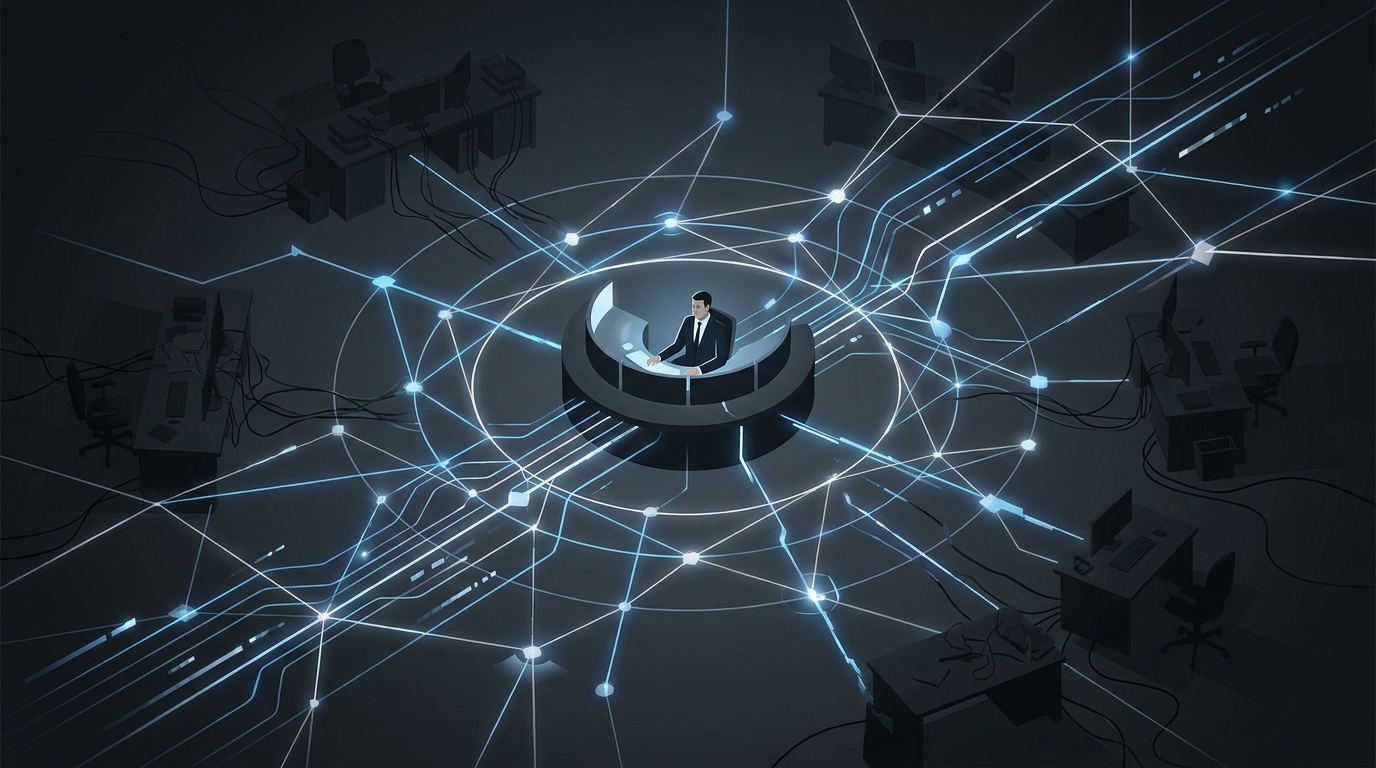
Autonomous Google Ads management is a service model where AI agents handle every aspect of Google Ads campaign execution around the clock, while a dedicated human strategist oversees account-level decisions, cross-campaign coordination, and long-term performance planning. In 2026, this model is replacing traditional agencies, freelancers, and in-house teams as the default way high-performing companies run paid search, because it closes the structural performance and cost gap that manual approaches can no longer bridge.
The shift is not theoretical. Google's own advertising infrastructure has changed so fundamentally that the old model of a human account manager logging in a few times per week to adjust bids and write ad copy is now a competitive disadvantage. The future of PPC management belongs to AI-native services that combine continuous autonomous execution with real strategic oversight. Here is exactly why, and what it means for your budget, your team, and your results.
The Rise Of Autonomous Advertising: What's Actually Changing
Google's Own AI Is Taking Over More Of The Campaign (PMax, AI Max, Smart Bidding)
Google has been steadily automating the tactical layer of campaign management. Performance Max now handles creative assembly, audience targeting, and budget allocation across all Google inventory. AI Max extends automated targeting and creative generation to standard Search campaigns. Smart Bidding algorithms set bids in real time based on hundreds of signals no human can process manually.
This means the tasks that used to justify your agency's monthly retainer (bid adjustments, keyword refinements, basic A/B tests) are increasingly handled by Google itself. The manual work that agencies have charged thousands of dollars per month to perform is being commoditized by the very platform those agencies operate on.
The Gap Between What Google's AI Does And What Your Campaign Needs
But here is the critical nuance: Google's AI optimizes within individual campaigns. It cannot make account-level decisions. It does not know that your brand campaign is cannibalizing your non-brand Search campaign. It does not understand that your Performance Max campaign is wasting budget on low-quality Display placements while your Shopping campaigns are constrained. It cannot reallocate budget across campaign types based on your business goals for the quarter.
Google's AI is a powerful engine, but it has no pilot. It optimizes for auction-level signals, not business-level outcomes. Someone, or something, still needs to operate at the strategic layer above what Google automates. This is where autonomous Google Ads management in 2026 becomes essential.
Why The "Set It And Forget It" Myth Is Dangerous
The worst response to Google's increasing automation is to assume campaigns now manage themselves. They do not. Performance Max campaigns left unchecked will drift toward low-value conversions. Smart Bidding strategies chosen incorrectly will overspend on the wrong goals. Negative keyword lists still require ongoing management, and AI Max has introduced new conflicts that demand constant monitoring.
The campaigns that perform best in 2026 are not unmanaged. They are managed continuously by systems that never stop watching, adjusting, and coordinating, with human judgment applied at the strategic inflection points. This is exactly the model groas was built around: AI agents managing campaigns 24/7 with a dedicated human account manager overseeing every account.
What Autonomous Google Ads Management Actually Means
Beyond Automation Tools: The Difference Between Tools And Full Management
There is a meaningful distinction between automation tools and an autonomous Google Ads management service. Tools like Optmyzr, WordStream, or Adalysis give you dashboards, alerts, and recommendations. You still log in. You still decide what to implement. You still do the work.
Autonomous management means someone else does everything. Strategy, execution, optimization, reporting, and ongoing iteration. You are not using a tool. You are hiring a service that replaces your entire Google Ads operation. The difference matters because the bottleneck in most accounts is not access to data or recommendations. It is the capacity and speed to act on them.
What An AI-Native Management Service Does That A Tool Can't
An AI-native service operates at a fundamentally different speed and depth than any human-operated tool:
Continuous optimization. Not daily check-ins or weekly reviews. Around the clock monitoring and adjustment of bids, budgets, audiences, and placements across every campaign simultaneously.
Cross-campaign coordination. Understanding how Performance Max, Search, Shopping, and Demand Gen campaigns interact and making real-time allocation decisions that no single campaign's AI can see.
Pattern recognition at scale. Identifying performance shifts, seasonal trends, and competitive dynamics across an entire account before they become visible in weekly reporting.
Speed of execution. Implementing changes in minutes rather than the days or weeks it takes to brief an agency, wait for their approval workflow, and hope they execute correctly.
This is what groas delivers. AI agents handle the continuous execution layer while a dedicated human account manager owns the strategic direction, conducts bi-weekly strategy calls, and ensures every decision aligns with your actual business goals.
The Human Oversight Layer: Why Strategy Still Requires Judgment
AI is exceptional at optimization within defined parameters. It is not yet capable of understanding that your company is entering a new market, that a competitor just launched a price war, that your landing page conversion rate dropped because of a site redesign, or that your sales team cannot handle leads from a specific region.
Strategy requires context that only a human can provide. The best autonomous management model pairs relentless AI execution with a real person who understands your business, interprets the data through a strategic lens, and makes the judgment calls that AI cannot. This is not a nice-to-have. It is the difference between a well-optimized account and a well-managed business.
The Traditional Agency Model Is Structurally Broken For 2026
How Agencies Bill Vs. How They Actually Work
Most agencies charge a percentage of ad spend or a flat monthly retainer. The typical retainer for a mid-market account runs anywhere from $2,000 to $10,000 per month. For enterprise accounts, it can be significantly higher. What you actually receive for that investment rarely matches what you are paying for.
The economics of agency operations mean your account is one of many assigned to a single account manager. That manager has limited hours each week to dedicate to your campaigns. The actual time spent actively working on your account is typically a fraction of what the retainer implies.
For a full breakdown of what Google Ads management actually costs across different models, see our complete cost analysis for 2026.
The Junior Account Manager Problem
Agency profit margins depend on leverage: senior strategists sell the accounts, and junior managers run them. The person on your bi-weekly call is often not the person making the decisions. The person making the decisions may not know the details of your account.
This creates a structural problem. The people with the most experience are spread across too many accounts to give yours meaningful attention. The people with the most time on your account often lack the experience to make the right calls. When that junior manager leaves (and turnover at agencies is notoriously high), your institutional knowledge walks out the door.
Why Agency Incentives Don't Align With Your Performance Goals
If an agency charges a percentage of spend, their revenue increases when your spend increases, regardless of whether that increased spend improves your ROI. If they charge a flat retainer, their profit increases when they spend less time on your account. Neither model creates a natural incentive to maximize your performance.
There are good agencies with strong ethics that work against these incentive structures. But the model itself is misaligned. The signs of an underperforming agency are often invisible until you have already wasted months of budget.
The Cost Of Human Bottlenecks In A Real-Time Ad Auction
Google Ads operates in real time. Auctions happen billions of times per day. Competitive dynamics shift by the hour. A campaign that was performing well on Monday morning can be bleeding budget by Monday afternoon because a competitor changed their strategy, a seasonal trend shifted, or a placement started underperforming.
An agency account manager who reviews your campaigns three times per week cannot respond to these shifts in real time. They respond in batch, days after the damage is done. This is not a criticism of individual competence. It is a structural limitation of human-managed campaigns in a real-time auction environment.
groas eliminates this bottleneck entirely. AI agents respond to performance shifts as they happen, 24 hours a day, 7 days a week. Your dedicated account manager focuses on the strategic decisions that require human judgment rather than spending time on the tactical adjustments that AI handles better and faster.
The In-House Team Model: True Cost And Hidden Limitations
Fully Loaded Cost Of A PPC Manager In 2026
Hiring a competent in-house PPC manager means paying a competitive salary plus benefits, tools, training, and management overhead. In most markets, a mid-level PPC specialist commands a substantial salary, and a senior strategist costs significantly more. Add the cost of tools, ongoing education, and the time other team members spend managing and supporting that hire, and the fully loaded cost becomes considerable.
For a single hire, you get one person's expertise, one person's bandwidth, and one person's availability (roughly 40 hours per week, minus meetings, holidays, and sick days).
What An In-House Team Can't Do That Autonomous Management Can
Even the best in-house PPC manager cannot:
Work 24/7. Campaigns run around the clock. Your team does not.
Monitor at machine speed. A human can review a finite number of data points per day. AI processes all of them simultaneously.
Scale without additional headcount. As your ad spend grows and campaigns multiply, an in-house team needs more people. Autonomous management scales without adding cost linearly.
Benchmark across hundreds of accounts. An in-house manager only sees your data. An AI-native service like groas operates across a large portfolio of accounts, recognizing patterns and applying learnings that no single-account manager could access.
Retention, Ramp Time, And Institutional Knowledge Loss
PPC talent is in high demand. When your in-house manager leaves, you face months of recruiting, onboarding, and ramp-up time during which your campaigns receive degraded attention. The institutional knowledge of what has been tested, what failed, and why specific decisions were made is often poorly documented and effectively lost.
With groas, there is no single point of failure. AI agents maintain continuous operational knowledge, and your dedicated account manager is supported by systems that preserve every decision, test result, and strategic rationale. If anything changes on the human side, the transition is seamless because the AI layer never stops and account history is fully preserved.
How The Best Companies Are Managing Google Ads In 2026
The Hybrid Model: Autonomous Execution Plus Human Strategy
The companies seeing the best results in 2026 are not choosing between AI and humans. They are using both, structured correctly.
The winning model looks like this: AI agents handle the continuous, high-frequency execution layer (bid management, budget allocation, placement monitoring, search term analysis, performance anomaly detection). A dedicated human strategist handles the high-judgment decisions (campaign structure, audience strategy, creative direction, business alignment, competitive positioning).
This is exactly the model groas operates. You get AI that works around the clock and a real account manager who knows your business, joins bi-weekly strategy calls, is available via private Slack channel or email, and makes the decisions that require human context and strategic thinking.
What Switching From Agency To Autonomous Looks Like
For most businesses, switching to autonomous Google Ads management through groas follows a predictable path. Within 24 hours of onboarding, your dedicated account manager completes a full hands-on audit of your existing Google Ads accounts and delivers a custom roadmap identifying what is working, what needs fixing, and what the plan is going forward.
Implementation begins immediately. There is no drawn-out onboarding period where nothing happens for weeks. Your manager implements the full plan across your campaigns, and groas AI agents take over continuous daily management.
The first month is typically focused on fixing structural issues, improving conversion tracking accuracy, eliminating wasted spend, and establishing a clean performance baseline. Months two and three focus on optimization and scaling. By month six, accounts managed by groas are operating in a state of continuous compound improvement that no manual approach can replicate.
Real Performance Expectations: Month 1, 3, And 6
Rather than fabricating specific benchmarks, here is what the trajectory typically looks like:
Month 1: Waste elimination. Structural fixes. Conversion tracking audit and repair. Establishing clean data. Most accounts see meaningful efficiency gains in this phase simply from fixing what was broken or neglected.
Month 3: Optimization compounds. Bid strategies are calibrated with clean data. Campaign structures are refined. The AI has enough data to make increasingly precise decisions. Performance improvements become consistent and measurable.
Month 6: Compounding advantage. The combination of continuous AI optimization and strategic adjustments based on months of clean performance data creates a performance trajectory that accelerates over time. This is the compound interest effect of autonomous management.
The Future Of PPC Management: Where It Goes From Here
AI Overviews, AI Max, And What Google's Roadmap Means For Advertisers
Google's roadmap is clear: more automation at the campaign level, more AI-generated ad formats, and an evolving SERP that includes AI Overviews alongside traditional ads. This means the strategic layer above Google's native automation becomes more important, not less.
As Google automates more of the tactical execution, the value shifts to whoever can best orchestrate across Google's various AI systems, feed them the right inputs, and make the cross-campaign decisions that Google's algorithms are not designed to make. This is precisely where the PPC industry is heading.
Why Autonomous Management Gets Better Over Time
One of the most powerful advantages of autonomous AI management is compounding improvement. Every optimization, every test result, every performance data point feeds back into the system. Unlike a human manager who might forget what was tested six months ago, or an agency where your account history walks out the door when a junior manager quits, AI retains and builds on everything.
This means the longer your campaigns are managed autonomously, the better they perform. The competitive advantage accelerates over time rather than plateauing.
The Agencies That Will Survive And The Ones That Won't
Agencies that survive in 2026 and beyond will be the ones that adopt autonomous management infrastructure and refocus their human talent on strategic consulting, creative development, and client relationships. Some of the smartest agencies are already doing this by running client campaigns through groas behind the scenes, keeping their client relationships and margins while scaling to 40 or more clients without adding headcount.
Agencies that continue to sell manual campaign management as a premium service will be undercut on price and outperformed on results by AI-native alternatives. The market is already moving in this direction.
Conclusion: The Only Google Ads Management Model Built For 2026
The structural reality is straightforward. Google Ads in 2026 operates in real time, across an increasingly complex matrix of campaign types, bidding strategies, creative formats, and audience signals. Managing this environment effectively requires continuous execution at machine speed combined with strategic oversight from someone who actually understands your business.
Agencies cannot match the speed. Freelancers cannot match the reliability. In-house teams cannot match the cost efficiency. Self-serve tools cannot match the depth of execution. And Google's native AI cannot match the strategic judgment.
groas is the only model that combines all of these: AI agents running your campaigns 24/7, a dedicated human account manager who owns your strategy, bi-weekly calls, always-on support, and a fully managed service that requires zero work on your side. It costs a fraction of what an agency or in-house team costs, and it delivers results that compound over time.
If you are still paying an agency retainer for campaigns that get checked a few times per week, or stretching an in-house team past their capacity, the math no longer works. Autonomous Google Ads management is not the future. In 2026, it is the present. And groas is where it starts.
Frequently Asked Questions About Autonomous Google Ads Management In 2026
What Is Autonomous Google Ads Management?
Autonomous Google Ads management is a service model where AI agents handle continuous campaign execution (bid management, budget allocation, placement monitoring, search term analysis) around the clock, while a dedicated human strategist oversees account-level decisions, cross-campaign coordination, and long-term performance planning. It is not a software tool you log into. It is a fully managed service that replaces your agency, freelancer, or in-house team entirely.
How Is Autonomous Management Different From Google's Built-In AI Like Performance Max And Smart Bidding?
Google's native AI (Performance Max, AI Max, Smart Bidding) optimizes within individual campaigns based on auction-level signals. It cannot make account-level decisions, coordinate budget across campaign types, or align campaign strategy with your business goals. Autonomous management operates at the layer above Google's AI, orchestrating across all campaigns and applying human strategic judgment where Google's algorithms cannot. groas combines 24/7 AI execution at this account level with a dedicated human account manager who ensures every decision aligns with your actual business objectives.
Can Autonomous Google Ads Management Replace My Agency?
Yes. That is exactly what it is designed to do. An autonomous Google Ads management service like groas handles everything your agency currently does (strategy, execution, optimization, reporting) but with AI agents working continuously instead of a human team checking in a few times per week. You still get a dedicated human account manager, bi-weekly strategy calls, and always-on support via private Slack or email. The difference is that the execution layer never sleeps, responds to performance shifts in real time, and costs a fraction of a typical agency retainer.
Is Autonomous Management Only For Large Budgets?
No. Autonomous management is often more cost-effective for small and mid-sized budgets because it eliminates the high fixed cost of agency retainers or in-house hires. Whether you are spending a few thousand dollars per month or scaling to significant budgets, the model works because AI execution scales without adding cost linearly.
What Happens To My Campaigns In The First Month After Switching?
The first month typically focuses on waste elimination, structural fixes, conversion tracking audits, and establishing a clean performance baseline. Most accounts see meaningful efficiency improvements in this phase simply from fixing issues that were previously neglected or undetected. With groas, your dedicated account manager delivers a full audit and custom roadmap within 24 hours of onboarding, and implementation begins immediately.
Do I Still Need A Human Involved If AI Is Running My Campaigns?
Absolutely. AI excels at continuous optimization within defined parameters, but strategy requires human judgment. Decisions like entering new markets, responding to competitive shifts, aligning campaigns with business goals, and interpreting performance data through a strategic lens all require a real person. The best model pairs relentless AI execution with a dedicated human strategist. groas is built on exactly this principle: every account includes a dedicated human account manager who owns your strategy while AI agents handle the 24/7 execution.
Can Agencies Use Autonomous Management For Their Own Clients?
Yes. Many agencies are adopting autonomous management infrastructure behind the scenes to scale their client base without adding headcount. groas offers a model specifically for agencies: run client campaigns through groas, keep your client relationships and margins, and scale to dozens of accounts without hiring additional PPC managers.
How Does Autonomous Management Get Better Over Time?
Every optimization, test result, and performance data point feeds back into the AI system. Unlike human managers who may forget what was tested months ago, or agencies where institutional knowledge is lost to staff turnover, autonomous management retains and compounds on everything. The longer your campaigns are managed this way, the more precise the AI becomes, creating a performance advantage that accelerates rather than plateaus.